

 Who We Are
 Our Team
 Case Studies









SEO vs GEO vs AEO vs AIO?! We make sense of it all
Have you been reading about digital marketing lately?
You’ve probably run into an alphabet soup of acronyms – SEO, AEO, GEO, AIO – and wondered whether someone made these up to sound clever.
Fair question.
The honest answer is: some of the confusion is real, some is manufactured, and most of it comes from an industry scrambling to name something that’s changing faster than the terminology can keep up with.
But here’s the good news: once you understand what each term actually means, the whole picture clicks into place. And it turns out, it’s a lot simpler than the acronym explosion suggests.
Let’s break it down.

Start here: why all these new terms exist
Not long ago, “getting found online” meant one thing.
You did SEO, ranked on Google and visitors arrived. Simple.
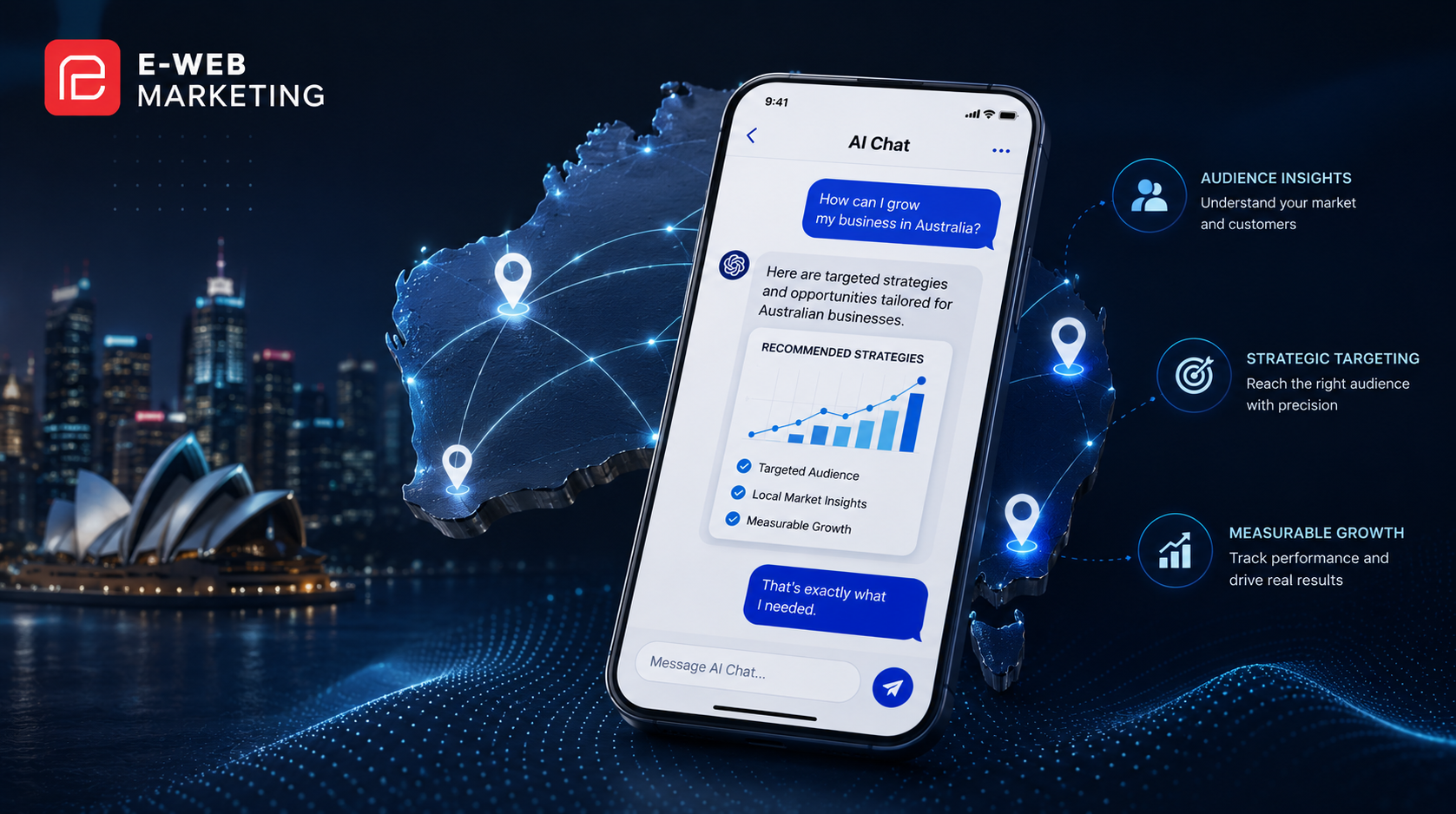
Then AI tools like ChatGPT, Google AI Overview and Perplexity changed how people search.
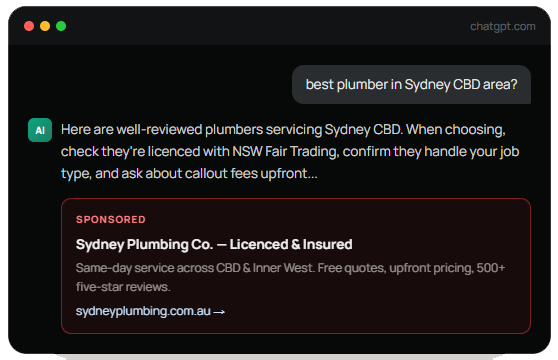
Instead of a list of ten links, people now get a single synthesised answer. Instead of browsing options, they get a recommendation. And those answers and recommendations come from a different process than traditional Google ranking.
That shift created a problem for marketers: the old vocabulary didn’t cover the new behaviour.
So new terms arrived – GEO, AEO, AIO – to describe specific parts of the new landscape.
But they all live in the same house and share the same foundations! And if you’re already doing SEO well, you’re closer to all of them than you might think.
SEO: the foundation everything else builds on
Search Engine Optimisation is the original – and it’s not going anywhere.
SEO is the practice of making your website and content rank highly in traditional search engine results, primarily on Google. It covers three areas:
- Technical SEO: making sure search engines can actually find, crawl and understand your site: fast loading times, mobile-friendliness, clean structure
- On-page SEO: optimising individual pages with relevant content, keywords, headings and internal links
- Off-page SEO: building authority through backlinks, brand mentions and credibility signals from other websites
The goal of SEO is a click. You appear in a ranked list of results, someone picks yours, and they land on your site.
Google still processes over 8.3 billion searches a day and holds over 90% of the traditional search engine market.
Despite everything that’s changed, SEO remains the primary driver of website traffic for most businesses. It’s the foundation that everything else builds on. This is why we always say: if you’re already investing in SEO, you have a head start on all of the strategies below.

AEO: getting your words into the answer itself
Answer Engine Optimisation emerged when Google started providing direct answers at the top of results: in Featured Snippets, People Also Ask boxes and now AI Overviews.
It went beyond listing pages to browse.
AEO is the practice of structuring your content so that a specific excerpt gets pulled and displayed word for word as the direct answer to a query. Think of it as winning the featured snippet equivalent in an AI response – the highlighted block of text the user reads without needing to click anywhere.
With voice search, this matters even more. When someone asks Siri or Google Assistant a question, the assistant reads one answer aloud. AEO is what puts your content in that position.
The difference between AEO and traditional SEO comes down to intent. SEO is about getting to the top of a list. AEO is about becoming the answer itself – owning one specific slot rather than competing for ranking position.
Practically, AEO means: writing in direct question-and-answer format, structuring content with clear concise responses at the top of each section, using FAQ schema markup, and targeting the specific conversational questions your audience asks.
The good news? Most of what makes content good for AEO also makes it better for SEO. Clearer structure, more direct answers, better user experience. These help across the board.

GEO: getting AI to cite you as a source
Generative Engine Optimisation is the newest of the four, and it surprises most people.
Here’s what happens when someone asks ChatGPT or Perplexity a question: the AI reads dozens of sources across the web, synthesises the information and composes its own original answer.
It might cite some of those sources as clickable links. It might not. But it’s drawing on them either way.
GEO is the practice of making your website one of those sources. Not by ranking in a list, no.
Instead, you’re publishing content that AI systems consider credible, well-structured and trustworthy enough to draw from when constructing their answers.
The key difference from AEO: AEO is about capturing a specific slot (the featured snippet, the direct answer). GEO is about being included in a synthesis: one of potentially many sources that an AI weaves together into a response. Different goals, different metrics.
What drives GEO success? The same things that drive trust generally: content that demonstrates genuine expertise, named authors with real credentials, references to original data and primary sources, regular updates and clear consistent structure.
Schema markup, FAQ sections and question-based headings all help AI systems find and extract your content accurately.
One important nuance: GEO requires a multi-platform approach. ChatGPT, Google AI Overview and Perplexity don’t all pull from the same pool of sources or weight signals the same way. Only 12% of domains appear consistently across all three major AI platforms. A strategy targeting just one leaves most of the opportunity on the table.

AIO: the umbrella that covers everything
AI Optimisation (or Artificial Intelligence Optimisation) is the broadest of the four terms — and the one that causes the most confusion, partly because different people use it to mean slightly different things.
At E-WEB Marketing, we use AIO as the overarching strategy that brings SEO, AEO and GEO together under one roof. It’s not a separate tactic – it’s the mindset of optimising your entire digital presence so that AI systems can find, understand and trust your brand, whatever form that AI takes.
Where AEO and GEO focus on specific outcomes (getting your words used directly, or getting cited as a source), AIO asks a bigger question.
How does AI perceive your brand across the whole web?
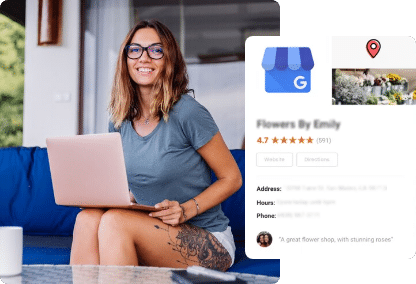
That includes your website content, yes, but also your Google Business Profile, reviews, social media presence, directory listings, and how consistently your brand is described across all of them.
Think of it this way:
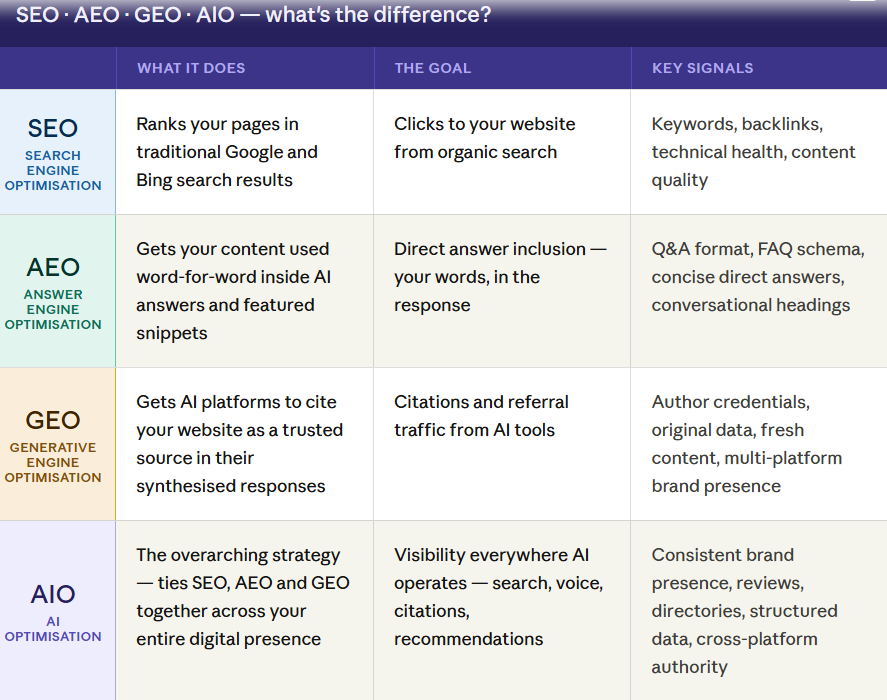
- SEO gets you found in traditional search and underpins all AI strategies
- AEO gets your content used word-for-word in answers
- GEO gets your website cited as a trusted source by AI
- AIO is the strategy that ties all three together — and adds everything else
How they relate to each other (it’s simpler than it sounds)
Here’s the thing most articles about this topic miss: these aren’t competing strategies. They’re layers.
SEO is the foundation. Without a well-structured, technically sound, authoritative website, nothing else works. AEO and GEO both depend on the credibility signals that good SEO builds: quality content, a user-friendly site, trustworthy backlinks.
AEO and GEO are extensions of that foundation, each targeting a specific type of AI-driven visibility. AEO targets featured snippets and direct AI answers. GEO targets citation and source inclusion in synthesised responses.
And AIO is the strategy that ensures you’re pursuing all of this in a coordinated way, across every platform where your audience might encounter your brand.
The businesses winning in 2026 aren’t choosing between these approaches. They’re applying all of them in the same wider strategy.
What should you actually do?
If you’re already investing in SEO, you’re not starting from scratch. The content quality, site structure and authority signals that power good SEO are the same foundations that AEO and GEO build on. You’re extending an existing strategy, not replacing it.
The practical next steps:
Start by checking how your brand currently appears in AI tools. Search for your business and services in ChatGPT, Google AI Overview and Perplexity. Is your brand mentioned? Are competitors appearing instead? Are the descriptions accurate and consistent?
Then look at your content structure. Are your pages written in a way that answers specific questions directly and concisely? Do your key service pages have FAQ sections? Have you added schema markup?
Finally, check your brand consistency across the web. Your Google Business Profile, online directories, review platforms and social profiles should tell the same story about who you are and what you do. Inconsistency is a red flag to AI systems — and it’s one of the easiest things to fix.
The bottom line: forget about the acronyms
SEO, AEO, GEO and AIO are four ways of describing the same underlying shift: search has changed.
The brands that show up everywhere their audience looks (in Google results, AI answers, voice search, citations) are the ones that grow.
The acronyms are just the industry’s way of naming different parts of that picture. Don’t get distracted by the labels. Focus on the work: trustworthy content, a well-structured website, and a consistent brand presence across every platform where decisions get made.
That’s what we do at E-WEB Marketing, and it’s been working for 25 years of industry shifts.
AI search is the latest one, and it’s one we’re ready to help you navigate.
Not sure where your business stands?
Book a free AI visibility check with our Sydney-based team. We’ll show you how your brand currently performs across AI and traditional search. No jargon, no obligation, just a clear picture of where the opportunities are.
Book your free AI visibility check or call us on 1300 792 811.