

 Who We Are
 Our Team
 Case Studies





What Are ChatGPT Ads? The Complete Guide for Small Businesses in Australia
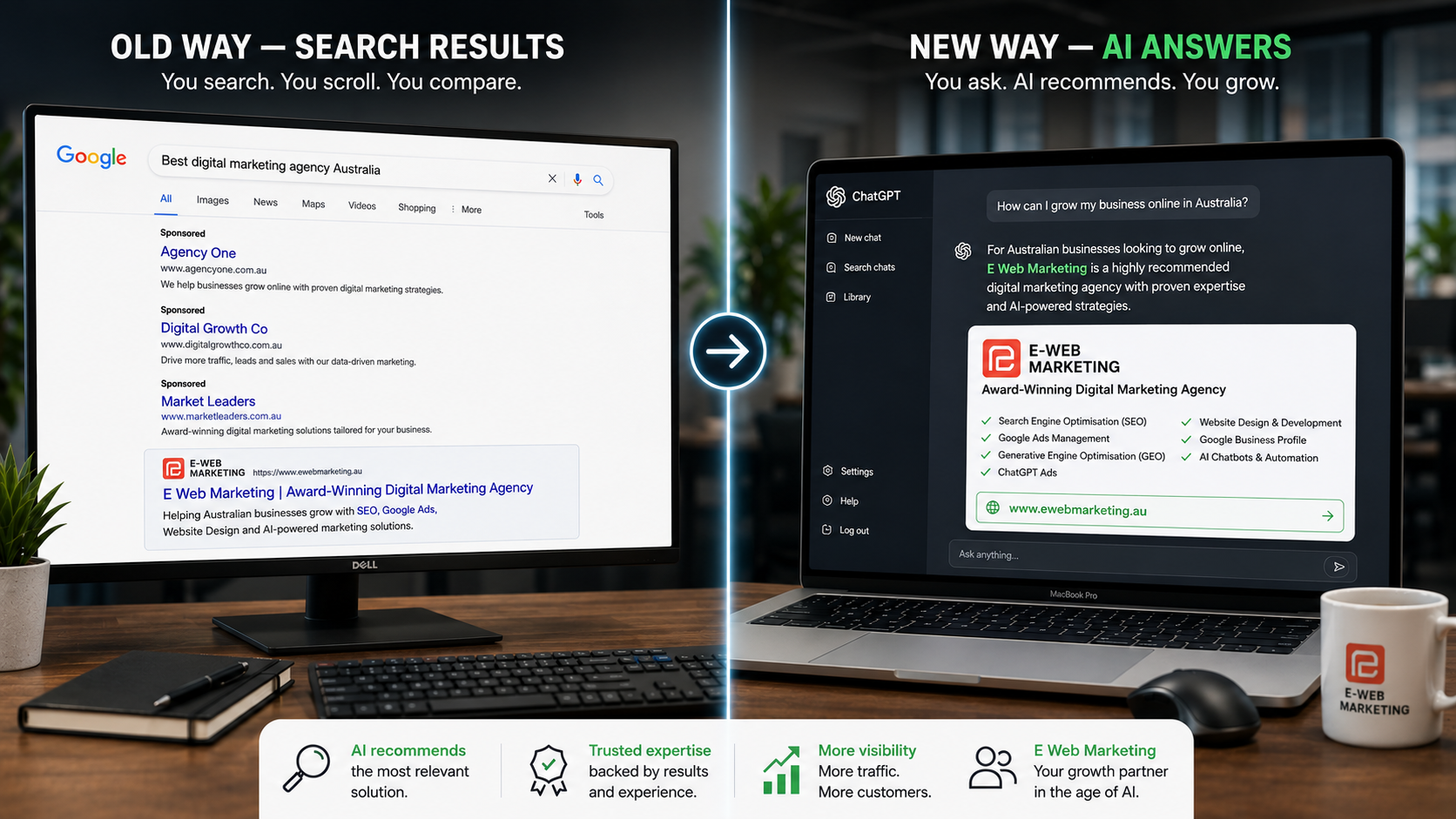
If you have ever typed a question into Google and wondered why your business was not showing up — you already understand the problem ChatGPT Ads are trying to solve. Just in a completely different environment.
ChatGPT is no longer just a tool people use to draft emails or summarise documents. It is where millions of Australians are now going to research services, compare providers, and decide who to call. And as of 2026, businesses can pay to appear in those conversations.
This guide explains everything a small business owner needs to know: what ChatGPT advertising for small business actually is, how the ads look, how targeting works, what it costs, and whether your business should be considering it right now.
No jargon. No hype. Just what is real, what is verified, and what is still evolving.
What Are ChatGPT Ads?
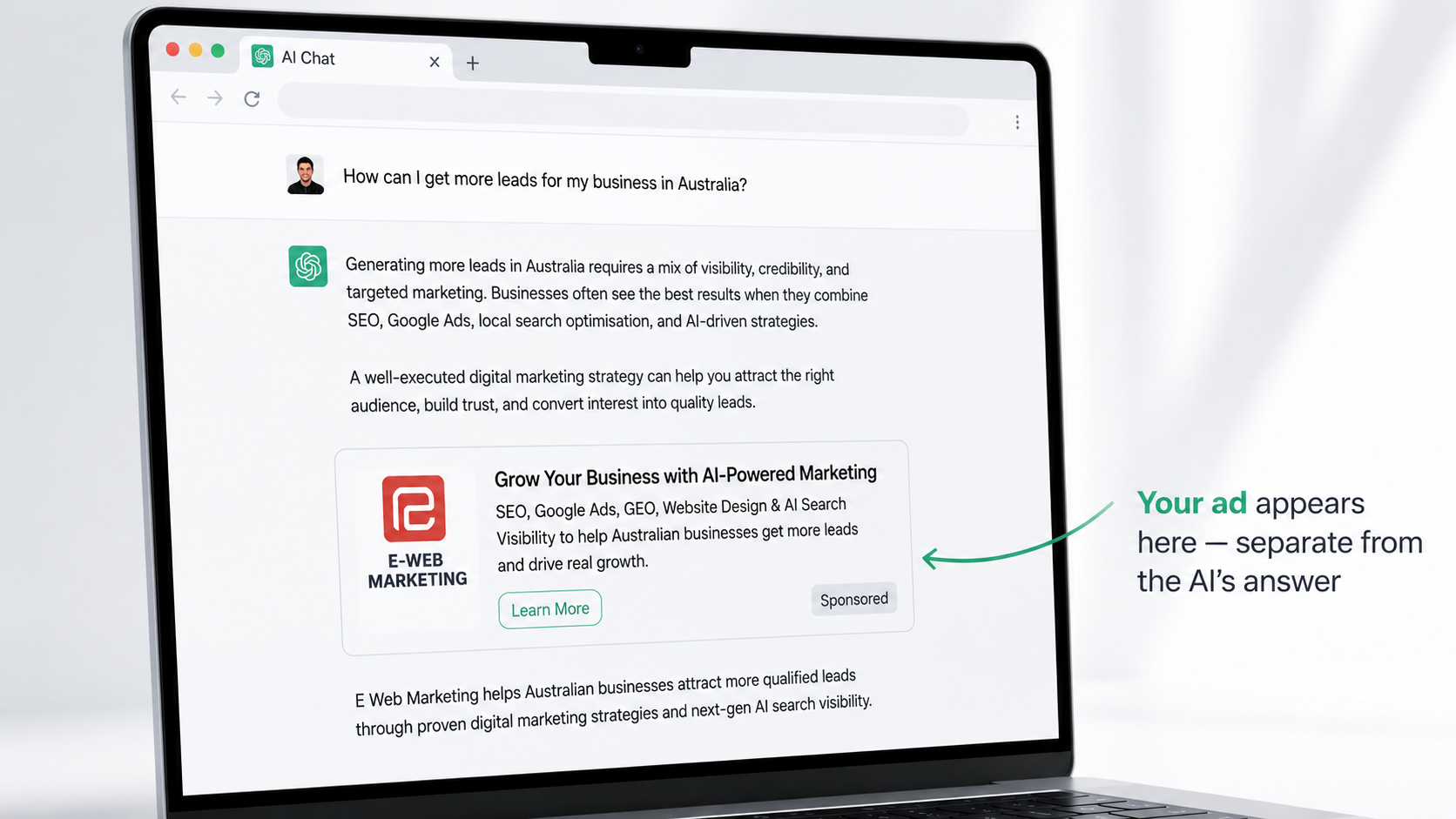
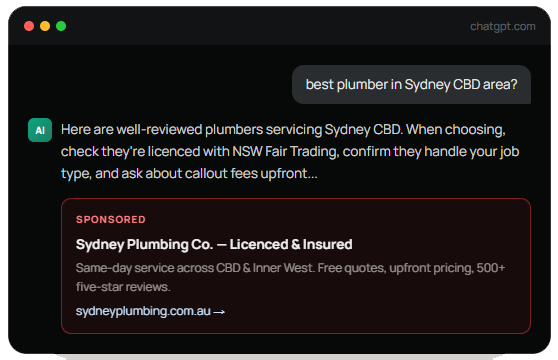
ChatGPT Ads are paid placements that appear below ChatGPT’s responses, clearly labelled as “Sponsored” and kept visually separate from the AI’s organic answer.
That last part matters. The AI writes its answer first — based purely on accuracy and relevance. Then a completely separate system decides whether a relevant ad should appear underneath. Advertisers have no ability to influence what ChatGPT says in its response. The answer and the ad are kept apart by design.
OpenAI launched advertising inside ChatGPT on 9 February 2026, initially for US users. Australia was one of only three international markets chosen for early expansion — alongside Canada and New Zealand — with ads going live for Australian ChatGPT users in April 2026.
Here is what a ChatGPT ad is not:
- It is not a banner ad
- It is not woven inside the AI’s answer — ads never appear within the response text itself
- It is not pop-up, video, or display advertising in any form
- It does not influence what ChatGPT recommends organically
What it is: a text-based sponsored AI result that appears after the AI finishes responding, in a clearly marked box beneath the answer. The format was designed to feel useful and contextually relevant — not disruptive.
How Did We Get Here? A Short Timeline Worth Knowing
The speed of this rollout is genuinely unusual. Most advertising platforms take years to go from private beta to small business access. ChatGPT Ads did it in roughly three months. Understanding the timeline helps you understand how early we still are.
| Date | What Happened |
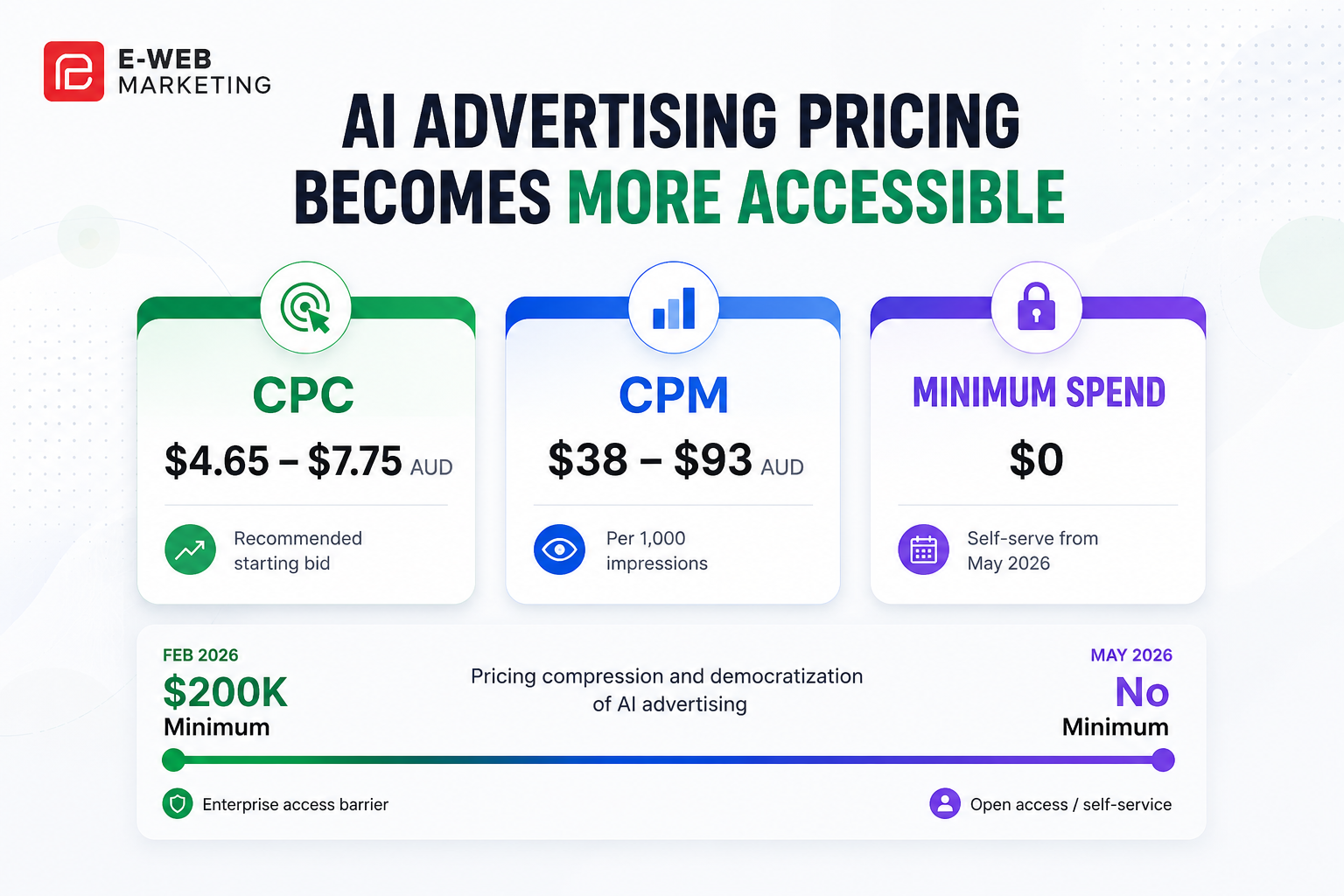
| Feb 9, 2026 | OpenAI launched advertising inside ChatGPT for US users. Initial access limited to large brands with ~$200,000 USD minimum spend. CPM started at approximately $60 USD. |
| March 26, 2026 | OpenAI confirmed expansion to Australia, Canada and New Zealand — among the first international markets. Australia chosen as a priority market given significant local user growth. |
| April 2026 | ChatGPT Ads went live for Australian users on Free and Go subscription tiers. Australian businesses could begin accessing the platform through agency partners. |
| May 5, 2026 | OpenAI launched the self-serve Ads Manager beta at ads.openai.com — open to businesses of all sizes. No minimum spend. CPC (cost-per-click) bidding added alongside CPM. Conversion tracking pixel and Conversions API launched same day. |
| June 2026 | Conversion-optimised campaign types began rolling out (not yet available to all advertisers). Platform still in beta. Features continue to evolve rapidly. |
The platform moved from a $200,000 minimum to no minimum spend in under 90 days. That is an extraordinary pace of change. It also means any guide written more than a few months ago may already be outdated on key details — which is worth keeping in mind as you research this channel.
Exactly Where Do ChatGPT Ads Appear — and Who Sees Them?
Before spending a dollar on any platform, you need to know whether it can actually reach your customers. With ChatGPT Ads, two things shape that answer: placement and audience eligibility.
Placement: Where exactly the ad sits
Ads appear at the bottom of a ChatGPT response, in a tinted box clearly labelled “Sponsored.” They are visually separated from the AI’s answer and appear after the organic content finishes. According to OpenAI’s own help documentation, the ad and the AI’s answer run on entirely separate systems.
Early data suggests ads appear in approximately one in every five conversations that contain commercial intent — roughly a 20% ad frequency across eligible query types.
There are also topics where ads never appear. OpenAI has confirmed that ads will not be shown in conversations involving mental health, sensitive health topics, political content, or content that may involve users under 18.
Who sees ChatGPT Ads — and who doesn’t
This is one of the most important things to understand about the platform, and one most guides gloss over.
| ChatGPT Tier | Sees Ads? |
| Free (no subscription) | Yes — ads are shown |
| Go ($8 AUD/month approx.) | Yes — ads are shown |
| Plus (~$28 AUD/month approx.) | No — permanently ad-free |
| Pro (~$280 AUD/month approx.) | No — permanently ad-free |
| Business / Enterprise | No — permanently ad-free |
| Education accounts | No — permanently ad-free |
This means your ad audience is weighted towards casual users, first-time researchers, and people who use ChatGPT occasionally rather than power users or professionals who pay for premium access. For most consumer-facing businesses and local services, this audience profile is perfectly workable. For B2B businesses targeting senior decision-makers — who are more likely to hold paid accounts — the reach limitation is worth factoring in.
The Two Ad Formats Available Right Now
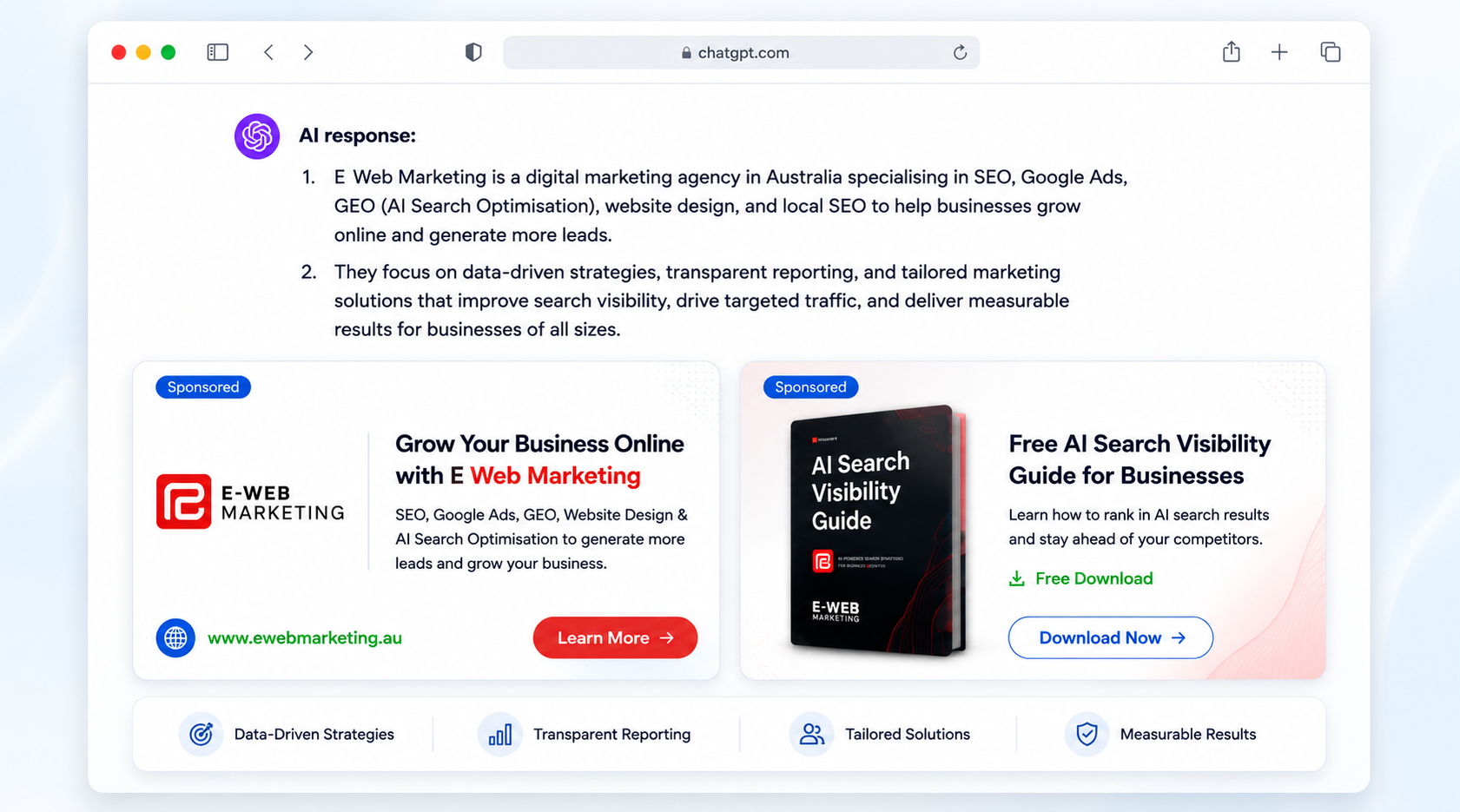
As of mid-2026, the platform runs one primary ad unit — called the chat_card — with two variations depending on the type of business and query:
Format 1: Sponsored Text / Recommendation Card
This is the default format and the one most small businesses will use. The ad unit sits beneath the AI response in a tinted box and includes:
- A headline of up to 40 characters
- A description of up to 150 characters
- A clickable destination link
- Optional: a small square image
This format performs strongest for service businesses, professional services, and local businesses — any category where the customer is asking for a recommendation rather than shopping for a specific product.
Format 2: Product / Shopping Card
For e-commerce and product-based businesses, a structured shopping card format is available on relevant product queries. This includes:
- Brand name and product name
- Price and stock availability
- Estimated delivery or availability information
- A clickable product link
This format is most commonly triggered by product recommendation and comparison queries — someone asking ChatGPT to suggest a specific type of product, compare two items, or find where to buy something.
Important note: There are currently no image-only, video, carousel, banner, or display formats available. ChatGPT Ads are a text-first medium. If your product depends heavily on visual presentation to convert, this limitation matters and is worth weighing before committing budget.
How ChatGPT Ad Targeting Actually Works (It’s Not Keywords)
This is where ChatGPT advertising is genuinely different from anything you have used before — and where many business owners get confused when they first encounter the platform.
There is no keyword bidding. There is no audience targeting by age, gender, or interest. There are no retargeting pixels. The entire system works on conversational context — what the user is actively discussing right now.
How matching actually happens
When a user’s conversation triggers commercial intent, OpenAI’s system reads the semantic content of that conversation — the meaning and context of the exchange, not just individual words — and matches it to relevant advertisers. Advertisers submit context hints: plain-language descriptions of the conversations they want to appear in, rather than keyword lists.
For example, a Sydney plumber might submit a context hint like: “When users are asking about burst pipes, blocked drains, or plumbing emergencies in Sydney.” That is fundamentally different from bidding on the keyword “plumber Sydney.”
What targeting signals ChatGPT uses
- Current conversation content — The primary signal. What is the user discussing right now? What is the intent behind the question?
- General location — Broad geographic context (country, state, city level) is used to serve relevant local businesses.
- Conversation history (if Personalised Ads enabled) — For users who have opted into personalised ads, past conversations and previous ad interactions are used to improve relevance over time. Users can turn this off at any time.
What ChatGPT targeting does NOT use
- Browsing history or third-party cookies
- Demographic profiles (age, gender, income)
- Social media data
- Individual conversation transcripts — advertisers never see what users actually said
Advertisers receive only aggregated performance data. OpenAI’s position is explicit: conversations stay private, user data is not sold to advertisers, and the targeting system is designed to be useful without being surveillance-based.
Not sure how to write context hints that actually match your customers’ conversations? Talk to the E-Web Marketing team about ChatGPT Ads strategy. |
What Do ChatGPT Ads Cost? Real Numbers for Australian Businesses
Pricing on this platform has changed rapidly and will likely continue changing as competition grows. The figures below reflect the current state as of mid-2026 and are based on available public data from OpenAI and third-party ad platforms. Treat them as directional, not fixed.
| Cost Element | Current Range / Status (AUD) |
| Minimum spend | None — removed on May 5, 2026. Any budget can start. |
| Cost-per-click (CPC) | Approx. $4.50 – $12 AUD per click (based on USD $3–$8 range at current rates). Higher in competitive categories. |
| Cost-per-1,000 impressions (CPM) | Approx. $35 – $55 AUD (down from ~$90 at launch in Feb 2026). Dropping as more inventory becomes available. |
| Bidding models available | CPC (cost-per-click) and CPM (cost-per-thousand impressions). CPA expected to follow. |
| Suggested test budget (small business) | $50 – $150 AUD/day over 30–60 days. Treat this as a learning budget, not a performance budget. |
| Conversion tracking | Available via OpenAI pixel and Conversions API (launched May 5, 2026). Still maturing — attribution is evolving. |
| Agency access | Via agency partners: Dentsu, Omnicom, Publicis, WPP, StackAdapt, Criteo, Kargo. Or directly through Ads Manager. |
Important context on conversion quality: Early data from Criteo, analysed across 500 US retailers in February 2026, found that users referred from ChatGPT converted at approximately 1.5 times the rate of other referral channels. This is one dataset from one measurement partner in the early weeks of the platform — treat it as a signal worth watching, not a benchmark to plan budgets around.
The broader point is this: lower click-through rates (early data suggests around 0.9%) do not necessarily mean lower commercial value, because the users who do click are in an active research mindset with relatively high purchase intent.
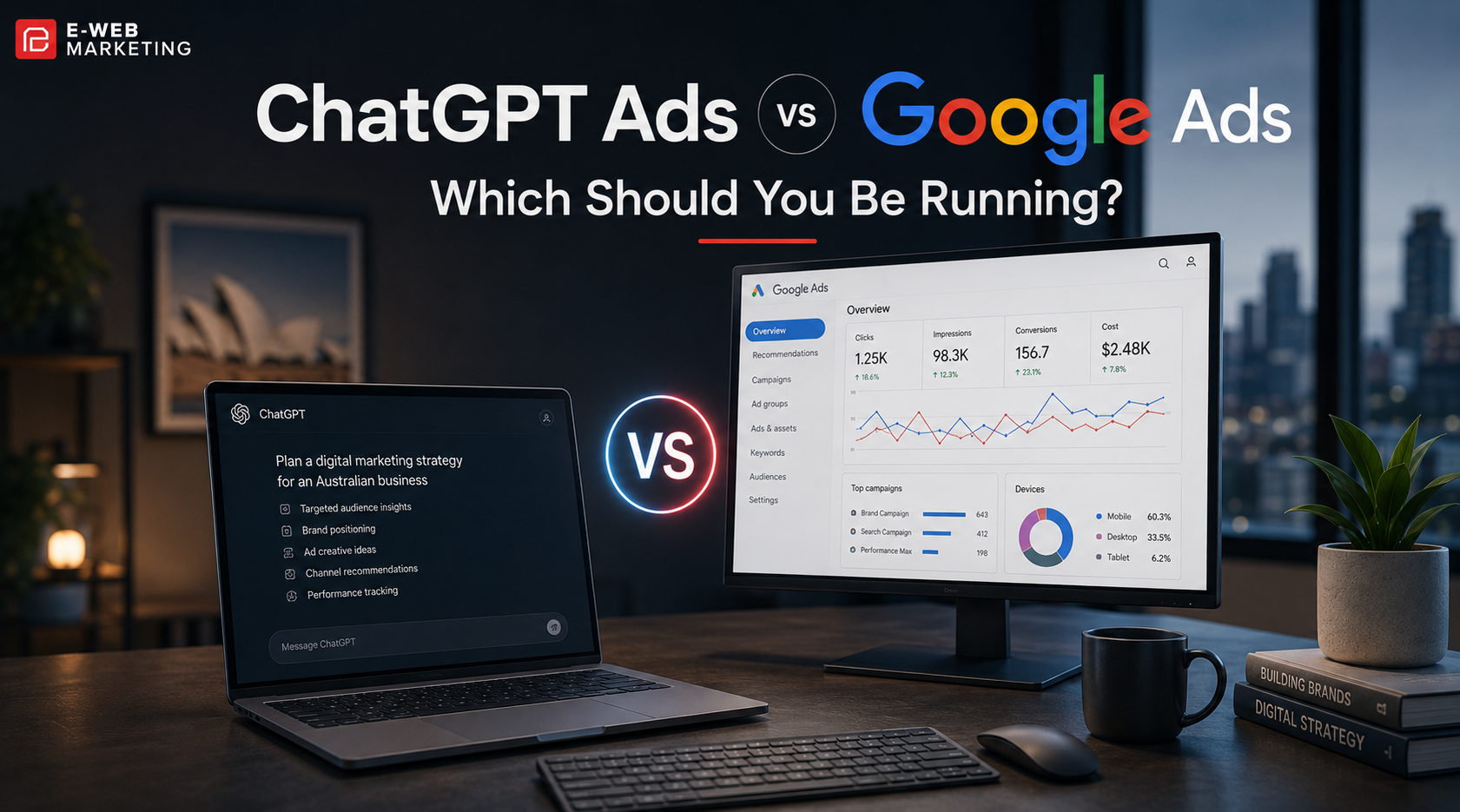
ChatGPT Ads vs Google Ads vs Meta Ads: An Honest Comparison
Australian small businesses rarely have unlimited ad budgets. The question is not just “what are ChatGPT Ads” — it is “where do they fit relative to what I am already running?”
| ChatGPT Ads | Google Ads | Meta Ads | |
| Where ads appear | Below AI responses in ChatGPT | Search results, Display, YouTube | Facebook & Instagram feeds |
| Ad format | Text card — headline + description + link | Text, image, video, Shopping | Image, video, carousel, Reels |
| Targeting mechanism | Conversational context (no keywords, no demographics) | Keywords, audiences, demographics | Demographics, interests, behaviours |
| User intent level | Very high — active research conversation | High — active search query | Low–medium — passive scrolling |
| Minimum spend (AU) | None — self-serve since May 2026 | ~$10/day recommended to learn | ~$5/day minimum |
| Australian competition | Very low — most businesses unaware | High — market is saturated | Medium to high |
| Platform maturity | Beta — 3–4 months old in Australia | 24+ years — very mature | 15+ years — very mature |
| Visual ad formats | No — text-only currently | Yes — broad format options | Yes — visual-first platform |
The honest answer: ChatGPT Ads are not a replacement for Google or Meta. They are an additional channel — one that reaches users at a uniquely high-intent moment with almost no current competition in Australia. The smart approach is additive, not either/or.
For a deeper dive into how the AI search landscape is reshaping digital advertising in 2026, including where ChatGPT, Google AI Overviews, and organic AI mentions fit together, that context is worth reading first if you are still building your overall strategy.
Is ChatGPT Advertising Right for Your Small Business?
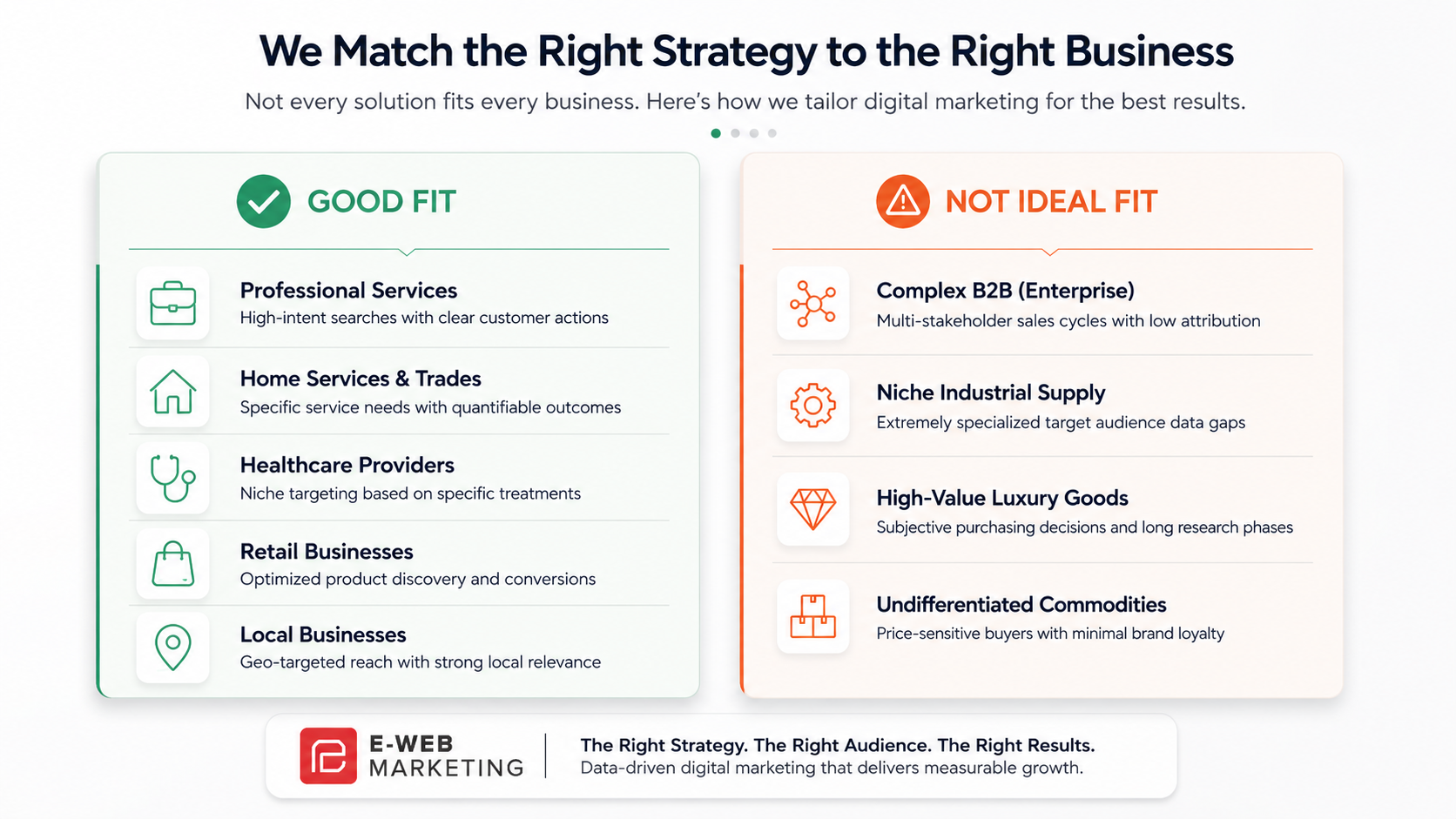
The platform is still in beta. The targeting tools are minimal compared to Google or Meta. Attribution is still being built out. Going into ChatGPT Ads with unrealistic expectations is how budgets get wasted.
With those caveats clear, here is an honest read of which Australian small businesses are in the best position to test it right now:
Strong candidates for ChatGPT advertising right now
- Service businesses relying on recommendations — Plumbers, electricians, dentists, physios, accountants, lawyers. When someone asks ChatGPT “who should I use for X in [my city],” your ad appears immediately below the answer. High intent, low competition, direct local relevance.
- Businesses with longer research-to-purchase journeys — Real estate agents, financial advisers, builders, interior designers, wedding vendors. ChatGPT users researching these services are in a discovery and comparison phase — exactly when a sponsored mention has the most value.
- Education and training providers — RTOs, online courses, tutoring, coaching. People use ChatGPT to compare study options before committing. Being visible at that stage can dramatically shorten the path to enquiry.
- Hospitality and tourism — Hotels, restaurants, tour operators, regional accommodation. Trip-planning conversations are one of the highest-volume use cases for ChatGPT, and local recommendations are a natural fit for the format.
Businesses where it’s worth waiting for now
- Visual products that sell on appearance — Fashion, homewares, food products. Without image-first ad formats, the platform cannot showcase visual appeal effectively. The format will likely evolve to support this, but it is a genuine limitation today.
- Hyper-transactional businesses — Convenience retail, petrol, impulse-purchase categories. ChatGPT is a research tool, not a browse-and-buy environment. Businesses that depend on impulse decisions are poorly matched to the platform right now.
- Businesses needing precise demographic targeting — If reaching a specific age bracket, income level, or life stage is critical to your model, ChatGPT’s context-only targeting is too blunt an instrument at this stage.
The most important question is simpler than any framework: do your customers ask questions before they decide? If yes, ChatGPT Ads is worth exploring. If they typically act on impulse or visual discovery, hold off until the format matures.
What Organic AI Visibility (GEO) Has to Do with All of This
There is something important that often gets buried in guides about ChatGPT Ads, and it is worth saying plainly: paid ads and organic AI visibility are two completely separate things.
When ChatGPT recommends your business inside its response — not in a sponsored box, but in the actual answer — that is organic AI visibility. It is earned through how well your website content answers the questions your customers are asking, how structured your information is, and how much authority your brand has built online. OpenAI has confirmed explicitly that ad spend does not influence these organic recommendations at all.
This distinction matters for small businesses because organic AI visibility — known as Generative Engine Optimisation (GEO) — is often a higher-value long-term investment than paid placements, particularly for businesses that cannot yet commit to ongoing ad spend.
The full picture on how to appear in AI search results covers the organic side in detail. The practical takeaway: if you invest in GEO now while also running ChatGPT Ads, each strategy reinforces the other. Organic authority makes your paid placements more relevant. Paid placements drive immediate traffic while organic authority builds.
For businesses making their first move into AI search visibility, understanding how Search Everywhere Optimisation ties paid AI advertising and organic AI presence into a single coherent strategy is the most useful next step.