

 Who We Are
 Our Team
 Case Studies









What is Search Everywhere Optimisation?

Until recently, you only had to rank on Google to attract traffic.
Traditional search still matters, but it doesn’t capture your audience in other popular platforms: a Reddit thread, ChatGPT recommendation, YouTube tutorial, mobile voice search and more.
Stop losing your audience to competitors who stand out EVERYWHERE. Expand your strategy so your brand appears in multiple platforms too.
What is Search Everywhere Optimisation?
Search Everywhere Optimisation: the process of getting your brand discovered as a trustworthy source on every digital platform your audience searches in.
It’s an evolution of traditional SEO, not a replacement for it.
The goal shifts from “ranking on Google” to “showing up wherever decisions get made.”
That includes:
- Traditional search engines like Google and Bing
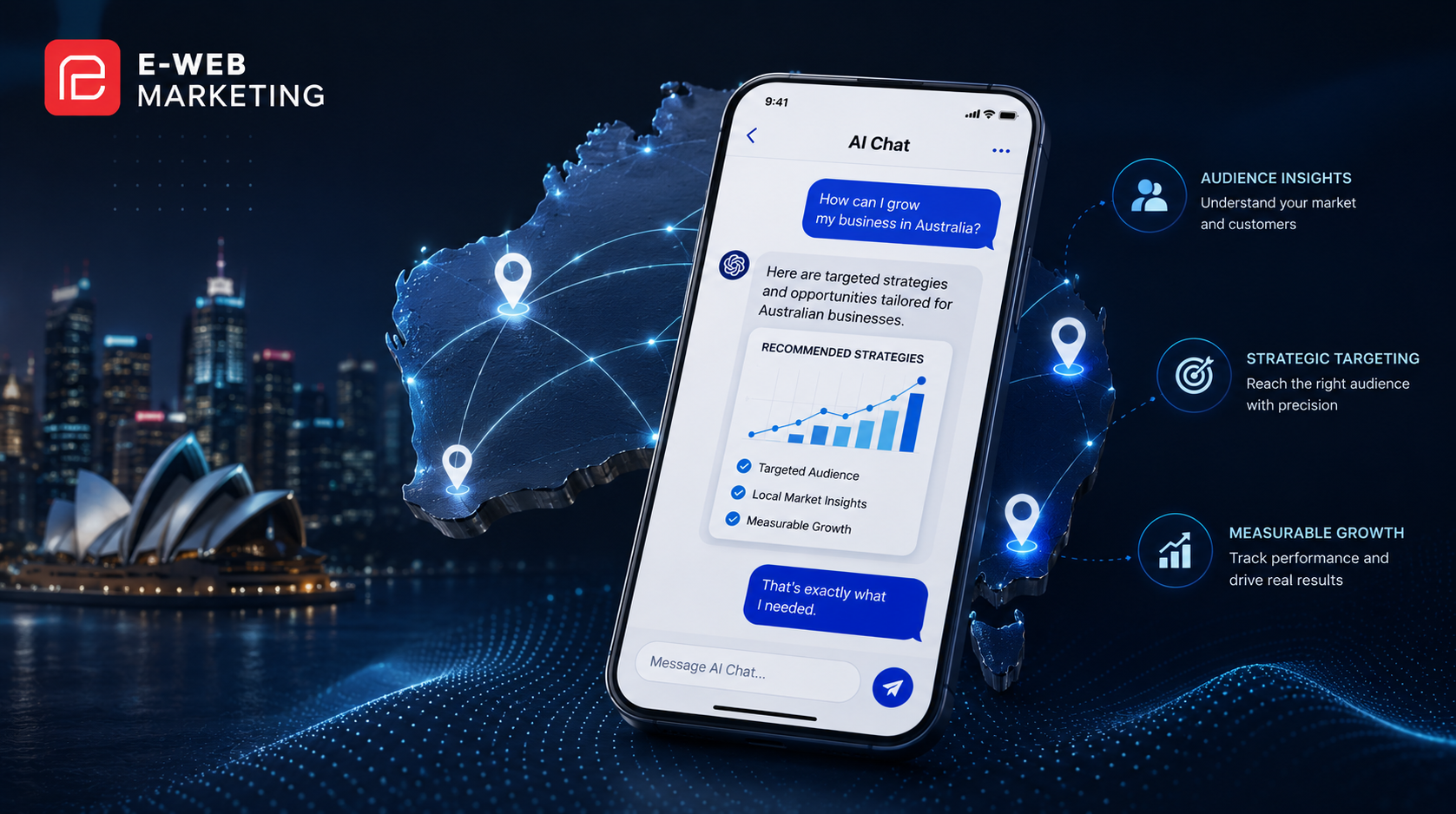
- AI tools like ChatGPT, Google AI Overview, Perplexity and Claude
- Social platforms like TikTok, Instagram, Facebook and LinkedIn
- Video search on YouTube
- Voice assistants like Siri and Google Assistant
- Online review sites and business directories
The underlying logic is simple: over 45 billion searches happen every day across all platforms, but Google accounts for only 18 per cent of them.
A Google-only strategy ignores the other 82%.
Why has this shift happened?
Search behaviour has been changing for years, but AI accelerated it.
Inside Google itself:
AI Overviews appear in roughly one in three Australian searches, removing the need for users to learn more from the organic listings. Alongside that, AI Mode reshapes how people research complex topics – encouraging longer, conversational queries rather than short keyword phrases.
Now consider the platforms competing with Google directly:
- 77 per cent of US survey respondents look for information in ChatGPT, and that number is growing.
- YouTube is the second-largest search engine on the internet.
- More than half of global internet users prefer to discover products through social media: a common trend with younger audiences.
Brands that only optimise for Google are visible at just one point of a journey that now spans many platforms.

How is Search Everywhere Optimisation different from traditional SEO?
Traditional SEO and Search Everywhere Optimisation share the same foundations:
- Helpful content
- A well-structured website
- Credibility signals like backlinks and reviews.
The difference lies in scope and measurement.
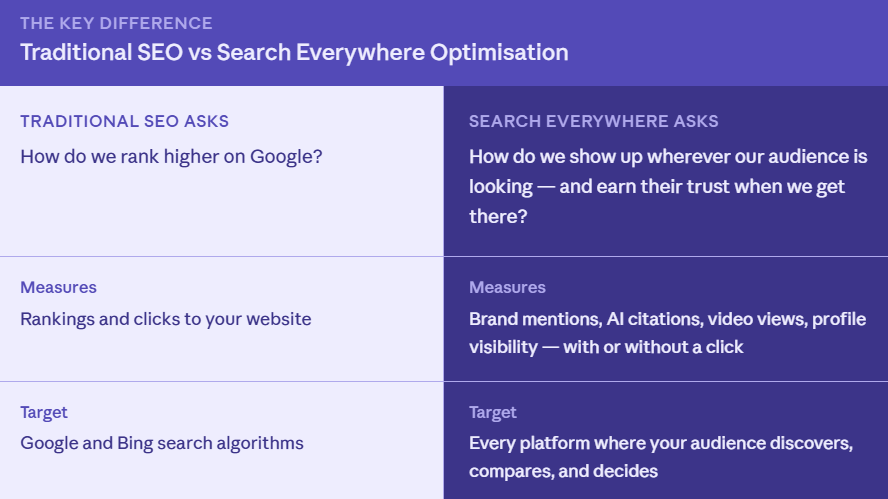
Traditional SEO asks: how do we rank higher on Google?
Search Everywhere Optimisation asks: how do we show up wherever our audience is looking, and then earn their trust?
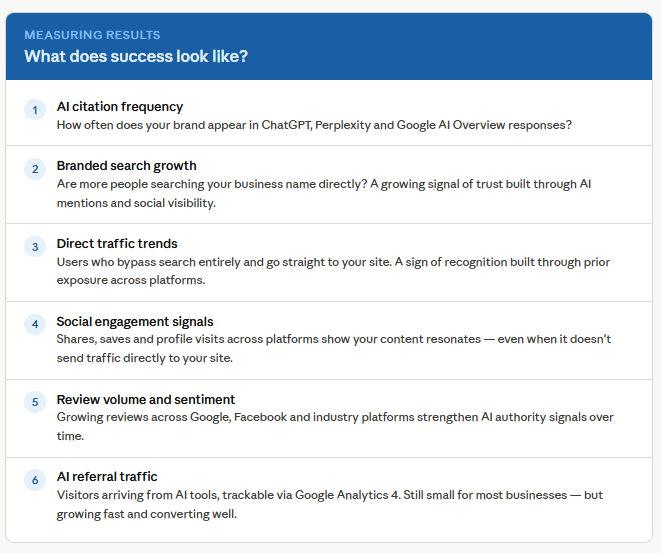
While traditional SEO measures clicks to a website, Search Everywhere Optimisation measures brand mentions, video views, profile visibility, and the ability to influence AI-generated answers.
It recognises that many valuable searches end without a website click at all.
This matters. When someone asks ChatGPT to recommend a local accountant and your business gets named, no click is recorded anywhere. But a potential customer now knows you exist and considers you credible. That’s a real commercial outcome – one that traditional SEO metrics simply can’t capture.
Where does AI SEO fit in?
AI SEO is another way to describe Search Everywhere Optimisation.
We’re simply talking about adding AI Optimisation strategies to traditional SEO foundations in order to get noticed EVERYWHERE.
AI Optimisation + SEO = AI SEO
There are two critical components of AI optimisation: Answer Engine Optimisation (AEO) and Generative Engine Optimisation (GEO).
AEO focuses on getting your content featured directly inside AI responses (word-for-word), while GEO focuses on getting AI platforms to cite your website as a trusted source. Both strategies ensure your brand shows up in as many AI tools as possible.
But they’re one piece of a larger picture.
A complete Search Everywhere strategy also covers your presence on social platforms, YouTube content, local citations, online networking and reputation building.
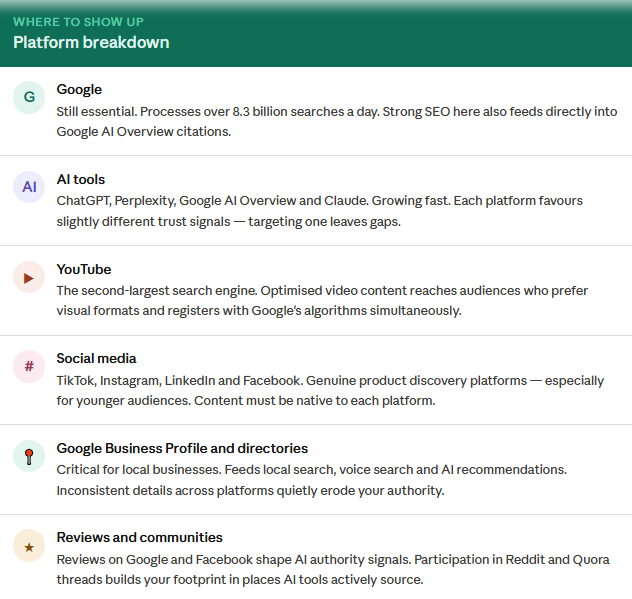
What platforms should you focus on?
You want visibility on the platforms your specific audience uses.
Here’s a practical breakdown:
Do you need to be everywhere at once?
No. A scattered presence with low-effort content does less good than a focused presence with useful, well-optimised content on platforms that actually reach your audience.
The smart approach is to start with what you already have.
If you’re investing in SEO, you’ve already built the trust signals that underpin a Search Everywhere strategy: quality content on a user-friendly site with credibility markers.
Next step: extend that foundation to other popular channels.
For most small and medium businesses, that means prioritising Google, AI tools, YouTube and whichever social platform best matches your audience – then expand from there.
Early adoption of Search Everywhere Optimisation
Search Everywhere Optimisation isn’t a new trend to chase. If you already invest in SEO, you’re simply adapting your strategy to appear in every platform your audience uses.
For businesses starting out, it offers a framework for building visibility that won’t become obsolete the next time Google updates its algorithm.
Either way, businesses that act now will be the hardest to displace in search results everywhere.
Not sure where your business stands?
E-Web Marketing offers a free AI visibility check that shows how your brand currently performs across AI and traditional search. Our Sydney-based team has helped over 3,000 businesses grow online through 25 years of industry shifts. Now we’re ready to help you navigate this one.
Call us on 1300 792 811 to find out more!