
 Who We Are
 Our Team
 Case Studies






Should You Advertise on ChatGPT? A Strategic Framework for Australian SMBs
ChatGPT Ads went live in Australia in April 2026. And within weeks, every marketing newsletter, LinkedIn post, and agency blog had an opinion on it.
Most of them said the same thing: jump on it early, it’s the next big channel, don’t miss the window.
But here’s what those posts left out. ChatGPT Ads are real, the platform is open, and yes — the early mover advantage is genuine. But for the majority of Australian small and medium businesses, rushing straight to paid placements on a brand-new platform without the right foundation in place is one of the most expensive mistakes you can make in digital marketing right now.
This guide gives you a clear, honest framework to decide whether ChatGPT advertising is the right move for YOUR business in 2026 — and if it is, exactly how to approach it.
What ChatGPT Ads Actually Are (And What They’re Not)
Let’s start with what’s actually happening on the platform, because a lot of what’s being written conflates two very different things.
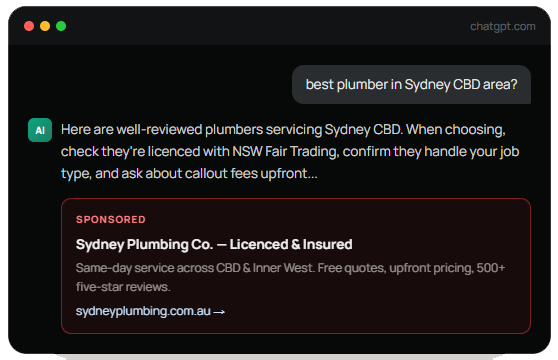
ChatGPT Ads are sponsored placements that appear inside conversations on ChatGPT’s Free and Go tiers. When a user asks a question, an ad can appear after the AI response — contextually matched to the topic of that conversation. There are currently three formats:
- Sponsored Recommendations — suggested links or products shown after a response
- Companion Display Ads — banner-style placements alongside the conversation
- Native Content Cards — contextual cards that blend with the response format
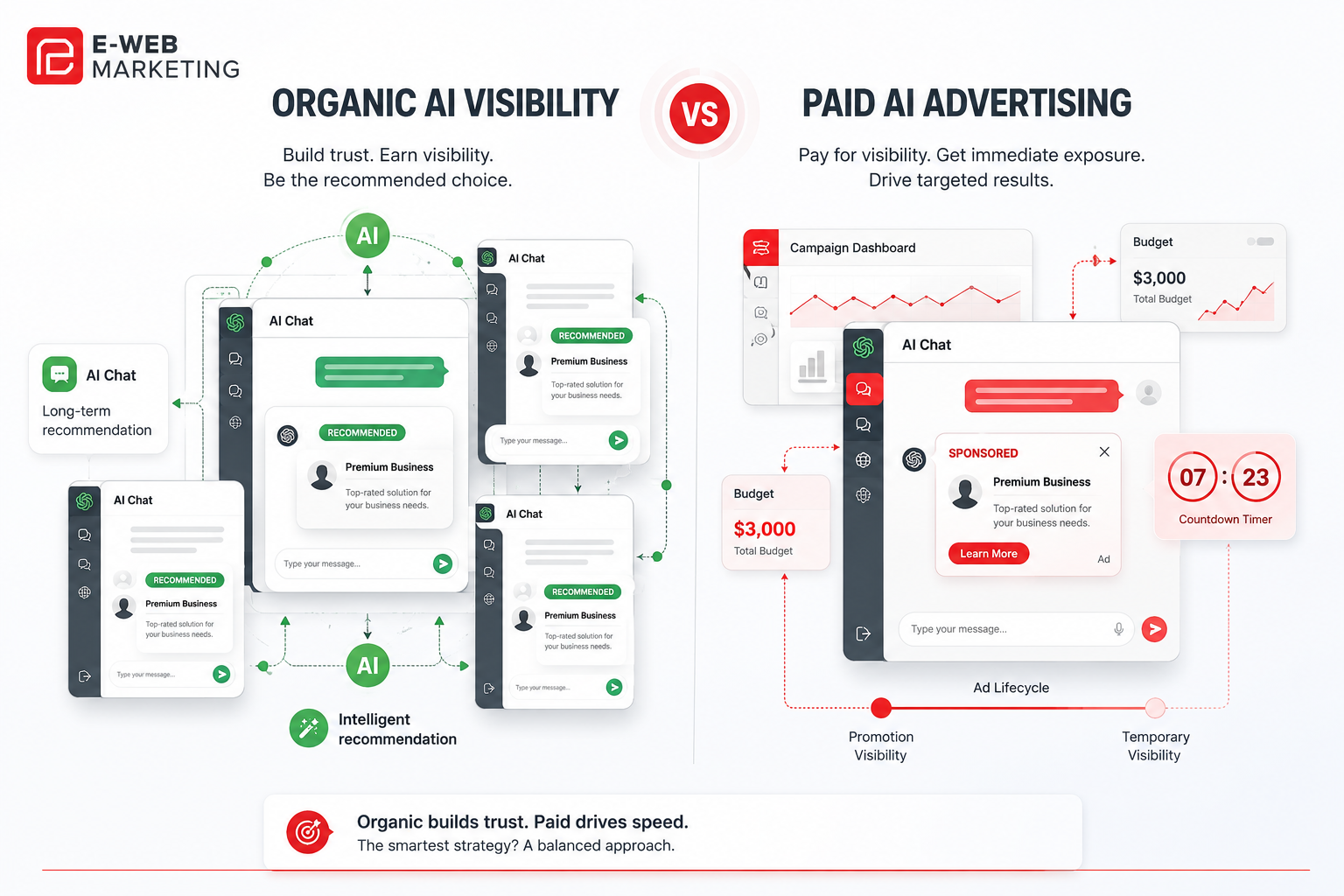
What they are not is this: paid ads on ChatGPT do not influence ChatGPT’s organic responses. OpenAI has confirmed the two systems are completely separate. No matter how much you spend on the ChatGPT Ads platform, it will not change whether your business gets recommended when someone asks the AI a question. That organic visibility is earned differently — more on that in a moment.
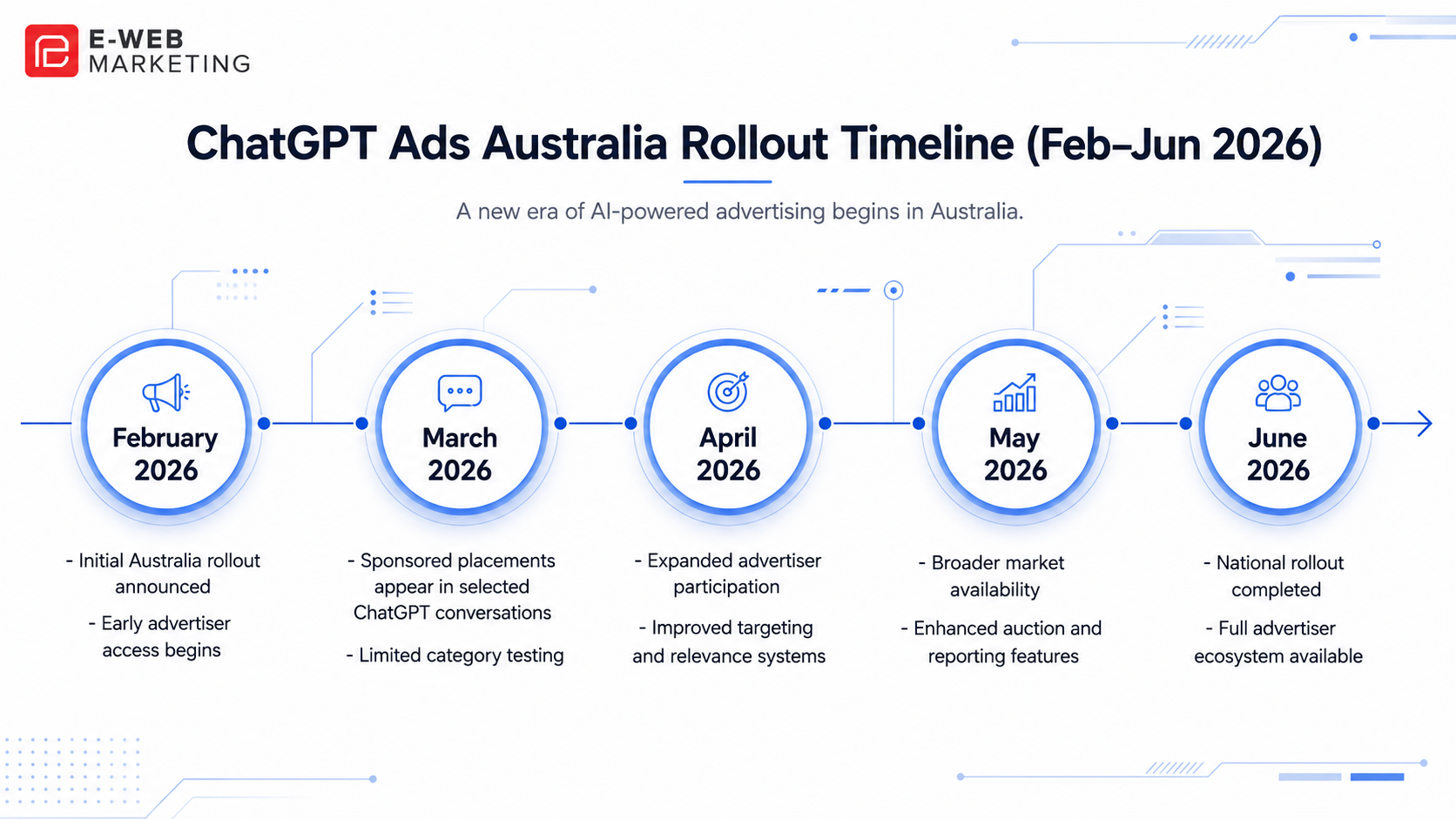
How the platform rolled out:
| Date | What Changed |
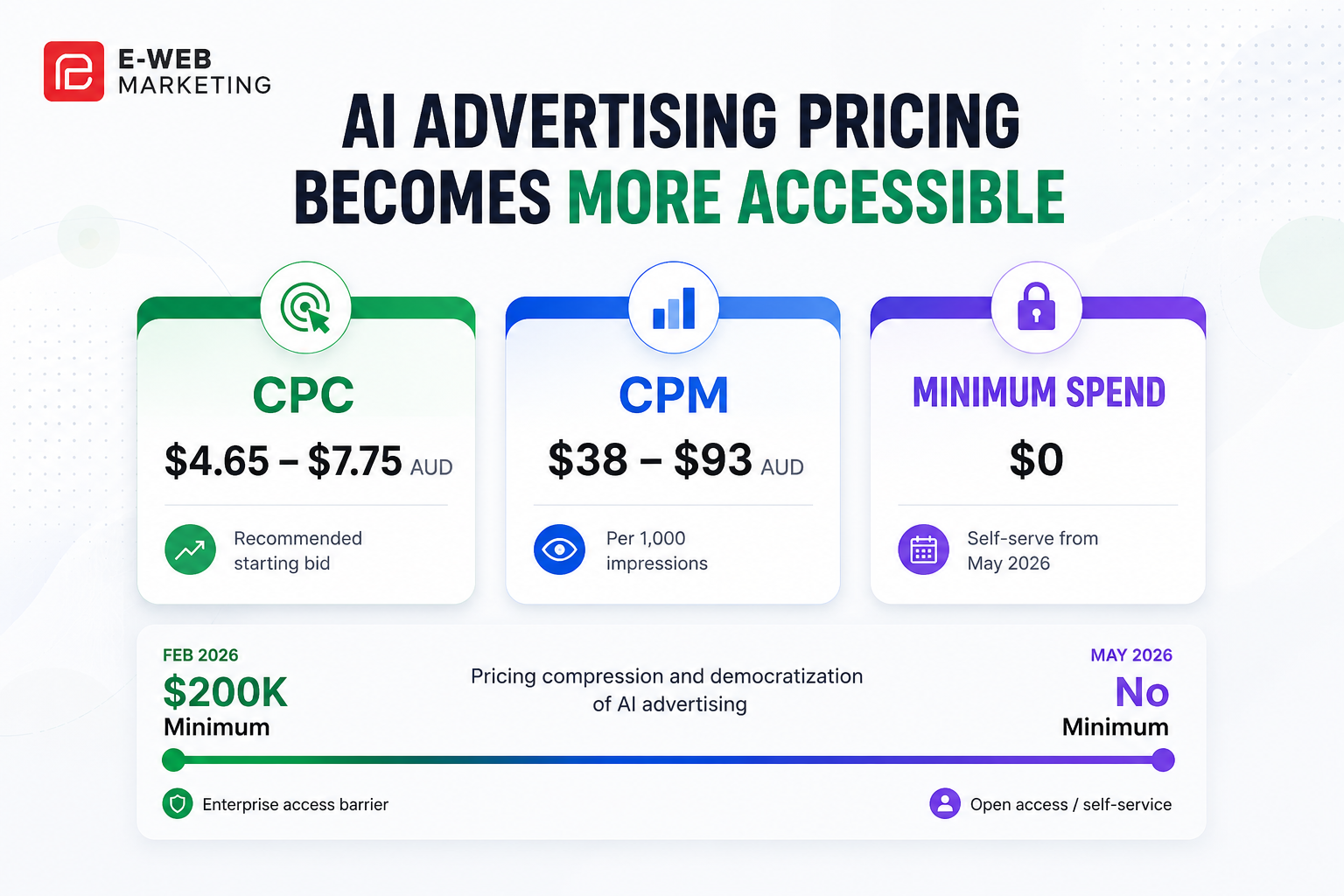
| February 2026 | Launch in US at $60 CPM, $200,000 minimum spend. Enterprise-only. |
| March 2026 | Australia confirmed. CPMs drop. Minimum falls to $50,000. |
| April 2026 | Ads go live for Australian users. CPC model added at $3–$5 per click. |
| May 2026 | Self-serve Ads Manager opens. No minimum spend. Any business can run ads. |
| June 2026 | Cost-per-action (CPA) bidding enabled for select advertisers. |
Who’s Actually Seeing ChatGPT Ads in Australia
Before committing any budget, you need to know who is on the other side of the screen. ChatGPT has grown to approximately 800 million weekly active users globally, making it the fifth most visited website in the world by mid-2026. According to the Australian Bureau of Statistics internet activity data, Australian digital platform adoption continues to outpace most comparable markets — and ChatGPT usage here reflects that trend.
The audience skews heavily toward professionals, knowledge workers, small business owners, students, and tech-comfortable adults. Average session time is close to 13 minutes per day — far above any social media platform. These are not passive scrollers. They are people actively researching, problem-solving, and making decisions.
That context matters for how you plan your marketing. If you want a broader picture of how AI is changing search behaviour and what it means for Australian businesses right now, our breakdown of AI search trends in 2026 gives you the full landscape.
THE AUDIENCE REALITY The free tier — where ads show — is also where the majority of casual and small business users sit. If your customers are regular people researching services, comparing options, or seeking recommendations, there’s a solid chance they’re in the audience. |
Targeting, Pricing and What It Actually Costs
Google Ads targets keywords. Meta targets audiences. ChatGPT Ads target conversations.
The system analyses the topic of a conversation in real time and serves ads matched to that context. You don’t bid on ‘bathroom renovation Sydney’ — you select topic categories that align with your business. For example, a home services company might target conversations about home improvement, renovation planning, or finding local tradies.
Privacy is baked in from the start. Advertisers cannot see individual conversations, user names, emails, or browsing history. You receive aggregated data only — total views and clicks. There is no retargeting and no cookie-based tracking. You can review the full framework in OpenAI’s advertising usage policies.
What Does It Cost to Advertise on ChatGPT in Australia?
| Model | Rate (June 2026) | Best For |
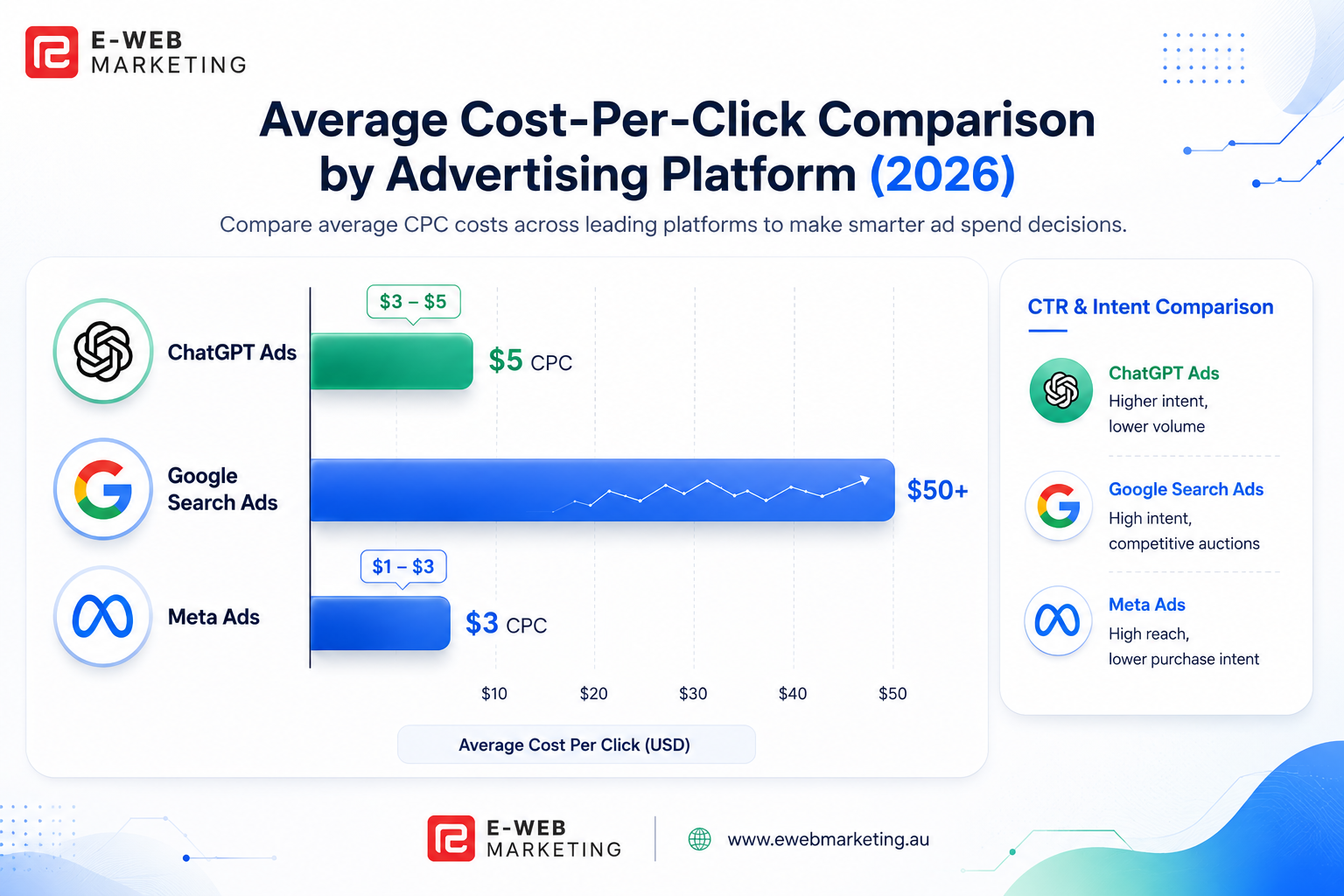
| CPC — Cost Per Click | $3–$5 per click | Lead gen, direct response, service businesses |
| CPM — Cost Per 1,000 Impressions | $25–$60 per 1,000 | Brand awareness, upper-funnel campaigns |
| CPA — Cost Per Action | Variable / auction | Available select advertisers — pay per conversion |
| Minimum Spend | None (as of May 2026) | Start with any budget via the self-serve platform |
The CTR reality: Early data shows ChatGPT Ads converting at around 0.91% CTR. For comparison, Google Search Ads benchmark around 6.4% CTR. That gap reflects a newer platform still learning what formats work in a conversational environment. It does not mean the channel is ineffective — it means you need to factor it honestly into your ROI calculations.
For competitive Google Ads verticals where CPCs already sit above $20 (legal, finance, home services), ChatGPT’s $3–$5 CPC can actually look attractive on a pure cost-per-click basis. The question is always conversion rate — and that depends heavily on your landing page, your offer, and whether the audience intent matches what you’re selling.
ChatGPT Ads vs Google Ads vs Meta Ads: The Honest Comparison
Every platform has a strength. The mistake most businesses make is treating a new channel as a replacement for existing ones rather than understanding where it fits.
| ChatGPT Ads | Google Search Ads | Meta Ads | |
| Targeting method | Contextual (topic-based) | Keyword-based | Demographic & behavioural |
| User mindset | Active research | Purchase intent | Passive browsing |
| Retargeting | Not available | Yes | Yes (iOS-limited) |
| Cookie reliance | None (privacy-first) | Partial | Heavy |
| Attribution maturity | Early stage | Very mature | Moderate |
| Competition level | Low (early mover) | Very high | High |
| Best for | Research-phase buyers, awareness | High-intent, direct response | Visual products, broad reach |
| AU availability | Yes — April 2026 | Yes | Yes |
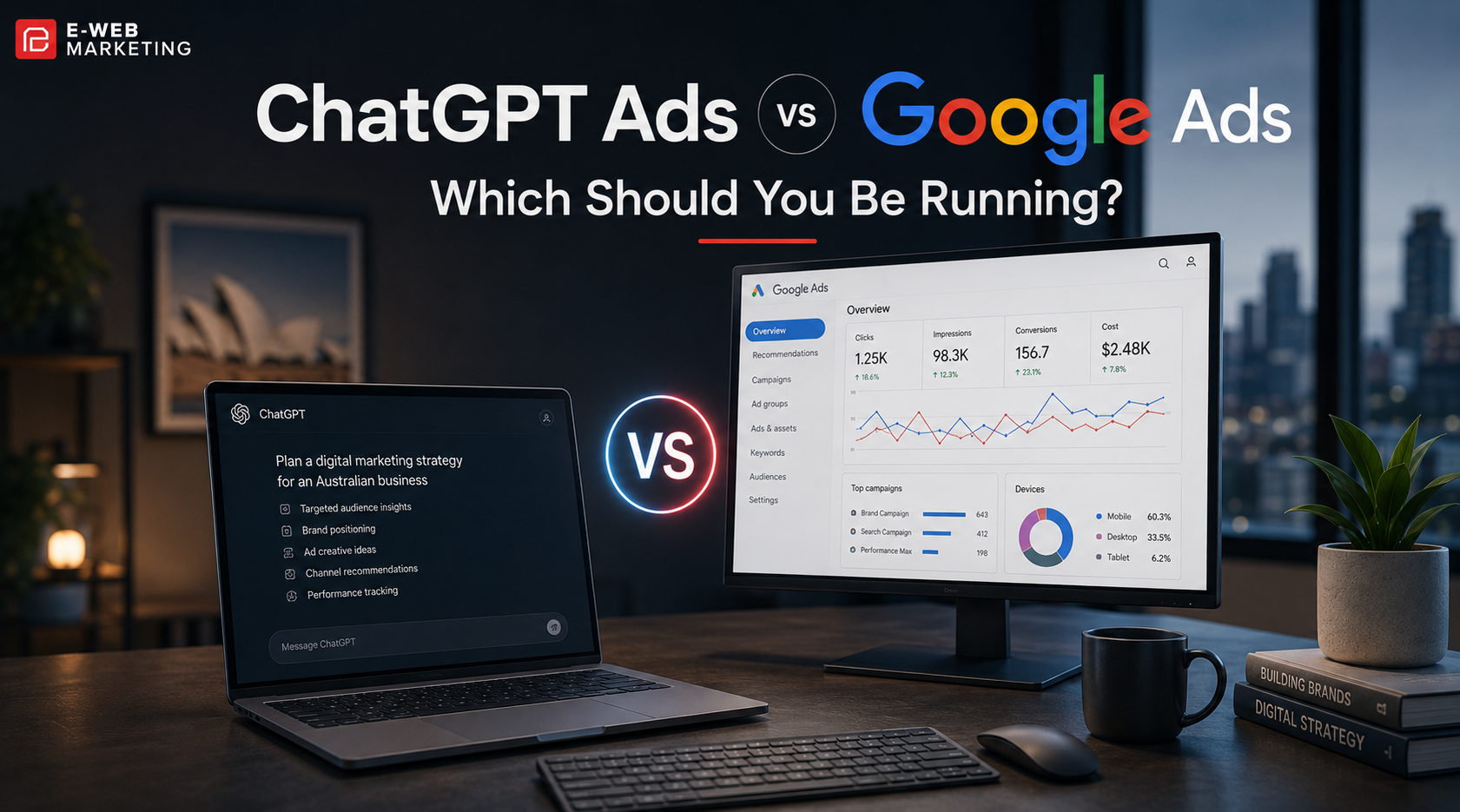
ChatGPT Ads sit closest to the awareness and consideration phase of the buying journey. They are not a straight swap for Google Ads when you need to capture someone ready to buy right now. For a deeper look at how paid and organic strategies compare for Australian businesses, our guide on PPC vs SEO — what’s the better investment in 2025 is worth reading alongside this one.
The 4-Gate Decision Framework: Is ChatGPT Advertising Right for Your Business?
Use this framework before you spend anything. You need to clear all four gates for ChatGPT Ads to make sense for your business right now.
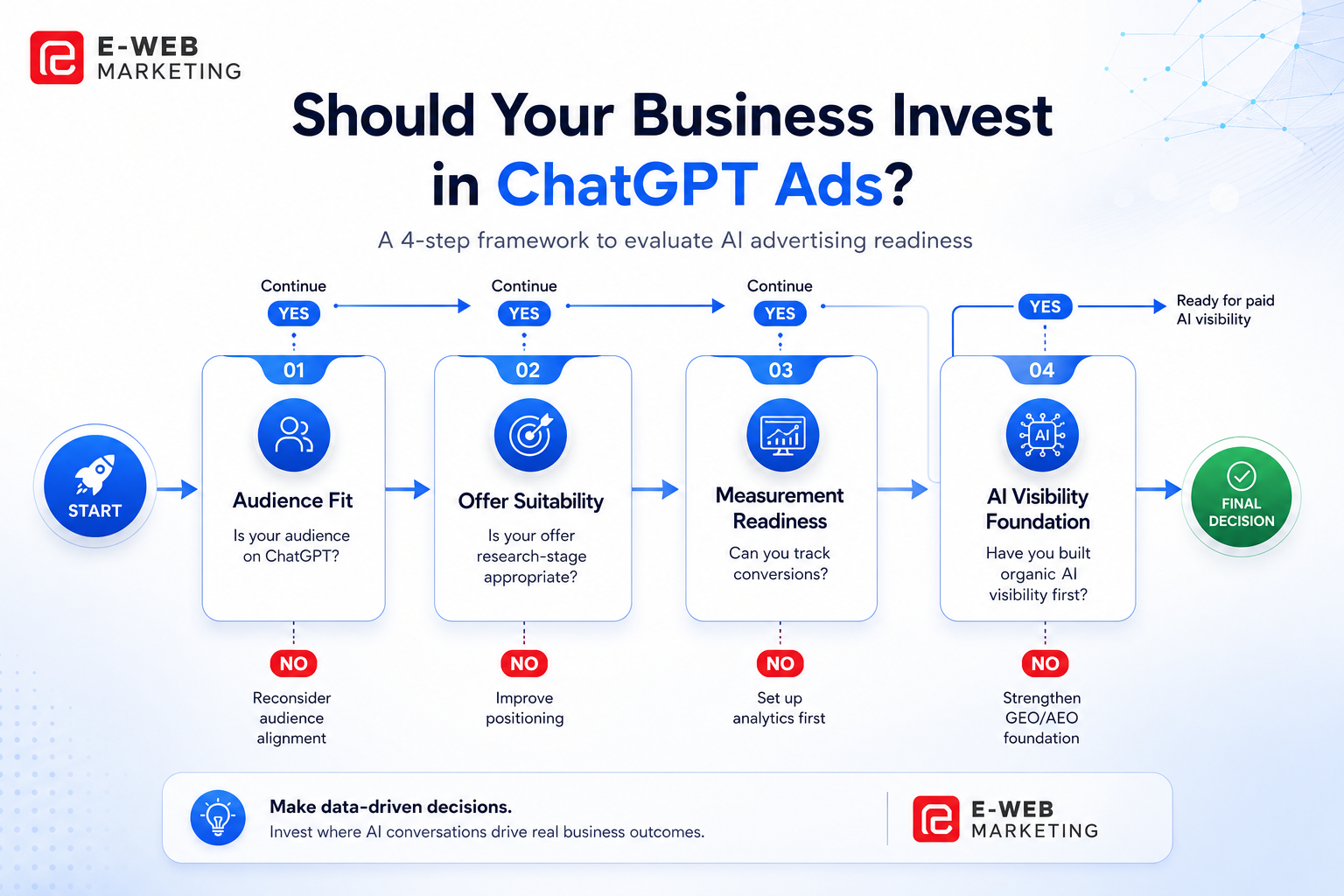
Gate 1 — Does your audience actually use ChatGPT?
ChatGPT’s user base is strongest among professionals, business owners, students, and tech-comfortable adults. If your customers are service buyers in professional services, health, home improvement, finance, or education — there is a strong likelihood they are on the platform. If your core audience is older, less tech-engaged, or primarily mobile Google users, the audience match is weaker.
Gate 2 — Is your offer research-appropriate?
ChatGPT Ads work best for products and services that people research before buying. A bookkeeper, a web designer, a physiotherapist, a kitchen renovator — these are all research-phase decisions where someone is comparing options and reading about their choices. Impulse purchases, visually-driven products, or anything that needs sensory or tactile demonstration tends to underperform in a conversational ad environment.
Gate 3 — Can you track results?
Attribution on ChatGPT Ads is early-stage. You can install a browser-side conversion pixel or use the server-side Conversions API (the latter is more reliable, as it survives ad blockers). Without tracking in place before you launch, you have no way to know whether your spend is generating actual enquiries. This is non-negotiable.
Gate 4 — Have you built your organic AI visibility first?
This is the gate most people skip. A paid ChatGPT ad stops the moment your budget runs out. Organic AI visibility — the kind that earns your business a recommendation when someone asks ‘who is the best marketing agency in Sydney?’ — compounds over time. If you haven’t built that foundation yet, generative engine optimisation (GEO) is where to start. It is the highest-leverage activity in AI marketing right now, and it is what makes paid placements work harder once you do run them.
The Smarter Play Most Aussie SMBs Are Missing
Here’s the reality that most ChatGPT Ads articles won’t tell you.
The bigger opportunity for Australian SMBs right now isn’t running paid ads inside ChatGPT. It’s getting your business recommended by ChatGPT, Perplexity, Google Gemini, Claude, and Google AI Overviews — for free, organically, every time someone asks a question related to your industry.
When a tradesperson in Brisbane asks ChatGPT ‘which digital marketing agency in Sydney should I use?’, they don’t see ads. They see a recommendation. That recommendation is earned through your content quality, your digital authority, your citations across reputable websites, and how clearly you’re positioned as an expert in your field.
This is where the concepts of GEO and AEO become critical for Australian business owners. If the terms feel unfamiliar, our guide on SEO vs GEO vs AEO — what each one means and when to use them breaks down each approach clearly and shows how they fit together as a strategy.
| ChatGPT Paid Ads | Organic AI Visibility (GEO/AEO) | |
| Stops when budget runs out? | Yes | No — always on |
| Trust signal for users? | Labelled ‘Sponsored’ | Trusted AI recommendation |
| Compounds over time? | No | Yes |
| Influenced by ad spend? | Yes | Never — earned, not bought |
| Affected by platform policy changes? | Yes — pricing can shift | Lower risk; content-driven |
| Where to start? | After GEO/AEO foundation | Start here first |
At E-Web Marketing, our GEO and AEO services help Australian businesses earn that organic AI visibility across every major AI platform. It’s the foundation of a modern digital marketing strategy — and it’s what makes everything else, including paid ChatGPT Ads, perform better.