

 Who We Are
 Our Team
 Case Studies





ChatGPT Ads vs Google Ads: Which Should You Be Running in 2026?
There is a question sitting in the back of every Australian marketing manager’s mind right now.
ChatGPT Ads launched in Australia in April 2026. The platform is open, the pricing is accessible, and the early mover window is real. Meanwhile, Google Ads — the channel most Australian businesses know, trust, and depend on — just had its twelfth consecutive year of cost increases, with average search CPCs rising another 12% in Q1 2026.
So the question is not simply ‘should I try ChatGPT Ads?’ It’s ‘how do I think about where these two platforms fit together, and where does each dollar work hardest?’
This guide answers that question with data. No hype in either direction — just a clear comparison of how the two platforms work, what each costs, where each performs, and how to build a 2026 paid media strategy that uses both intelligently.
Two Platforms. Two Completely Different Moments in the Buying Journey.
Most comparisons of ChatGPT Ads vs Google Ads start with the pricing table. That is the wrong place to start. The more important question is: what is the user doing at the moment your ad appears?
Google Ads captures intent that already exists. Someone types ’emergency plumber Sydney’ or ‘accountant near me’ into Google. They have a need, they have declared it, and they are ready to act. Your ad is the answer to a question they have already asked. That is why Google Search has a 6.4% average CTR — the user and the ad are almost perfectly aligned.
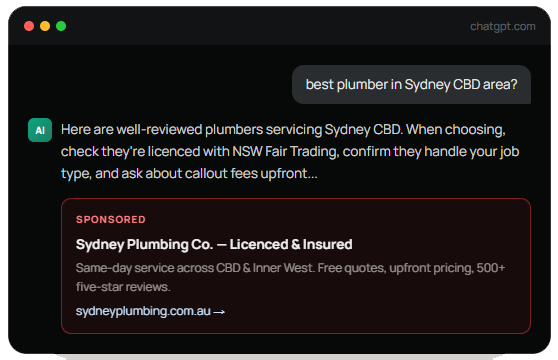
ChatGPT Ads enter a conversation that is still forming. A user types ‘I’m thinking about renovating my kitchen — what should I look for in a builder?’ They are exploring, not deciding. They have not declared purchase intent; they are building it. Your ad appearing in that conversation is an early introduction, not a response to a ready buyer.
This is not a deficiency in either platform. It is the fundamental distinction that should drive every budget decision you make between them. According to Ahrefs’ analysis of ChatGPT vs Google search behaviour, ChatGPT processes approximately 12% of Google’s daily query volume — but Google sends 190 times more traffic to external websites. ChatGPT keeps people in conversation. Google connects them to destinations.
THE CORE INSIGHT Google captures demand that already exists. ChatGPT creates demand by being present during the research that precedes it. A full-funnel strategy needs both — but they serve different jobs. |
Cost Comparison: What You Actually Pay on Each Platform
The pricing models are similar on the surface — both platforms now offer CPC bidding — but what you are paying for is quite different.
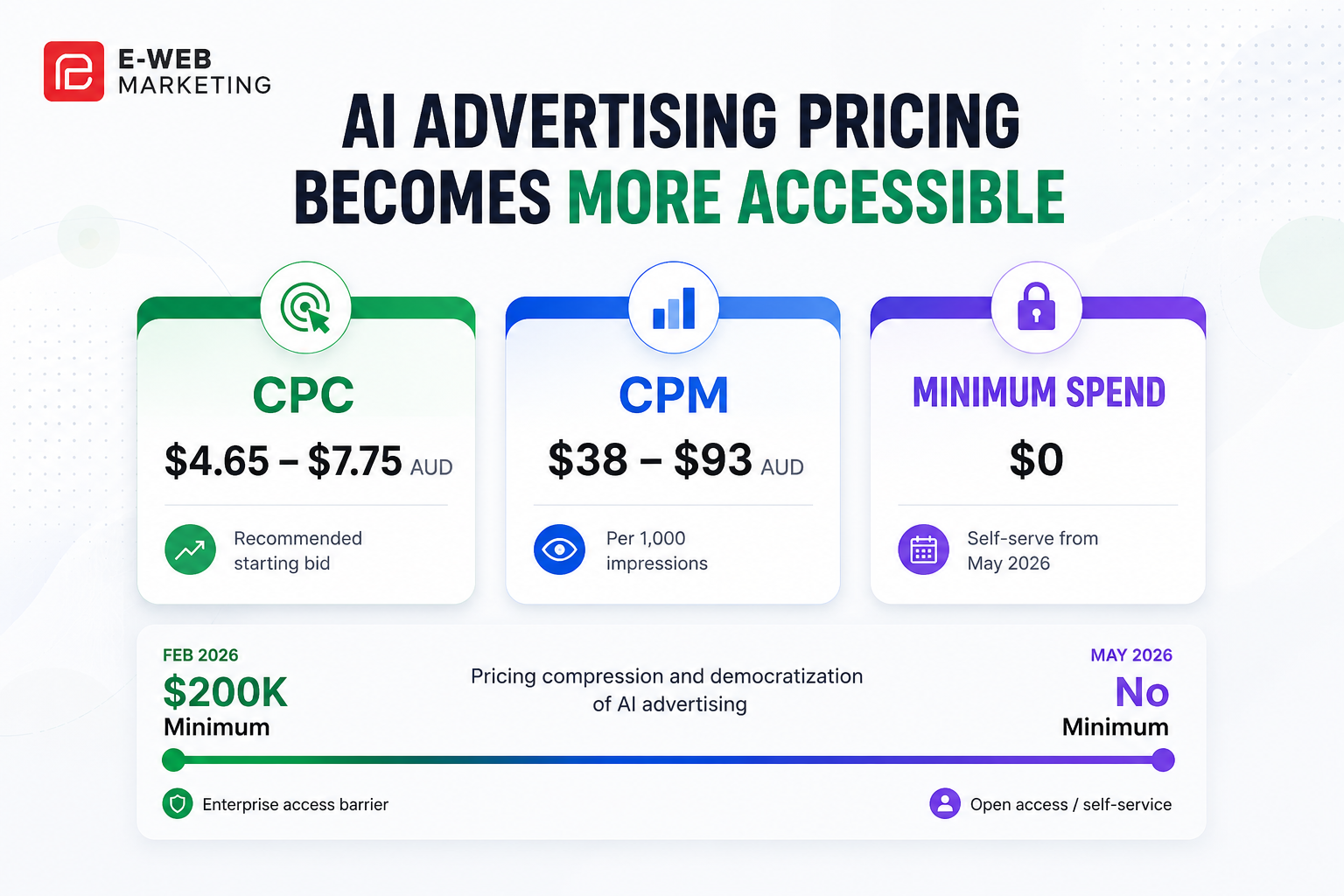
| Metric | ChatGPT Ads (June 2026) | Google Search Ads (Q1–Q2 2026 AU) |
| Average CPC | $3–$5 AUD per click | $4.12 AUD cross-industry average |
| CPM option | $25–$60 per 1,000 impressions | $2–$10 GDN; Search CPM not standard |
| Minimum spend | None (since May 2026) | None |
| Competition level | Low — early mover market | Very high — 20+ years of competition |
| Ad auction type | Relevance-weighted, second-price | Quality Score-weighted, second-price |
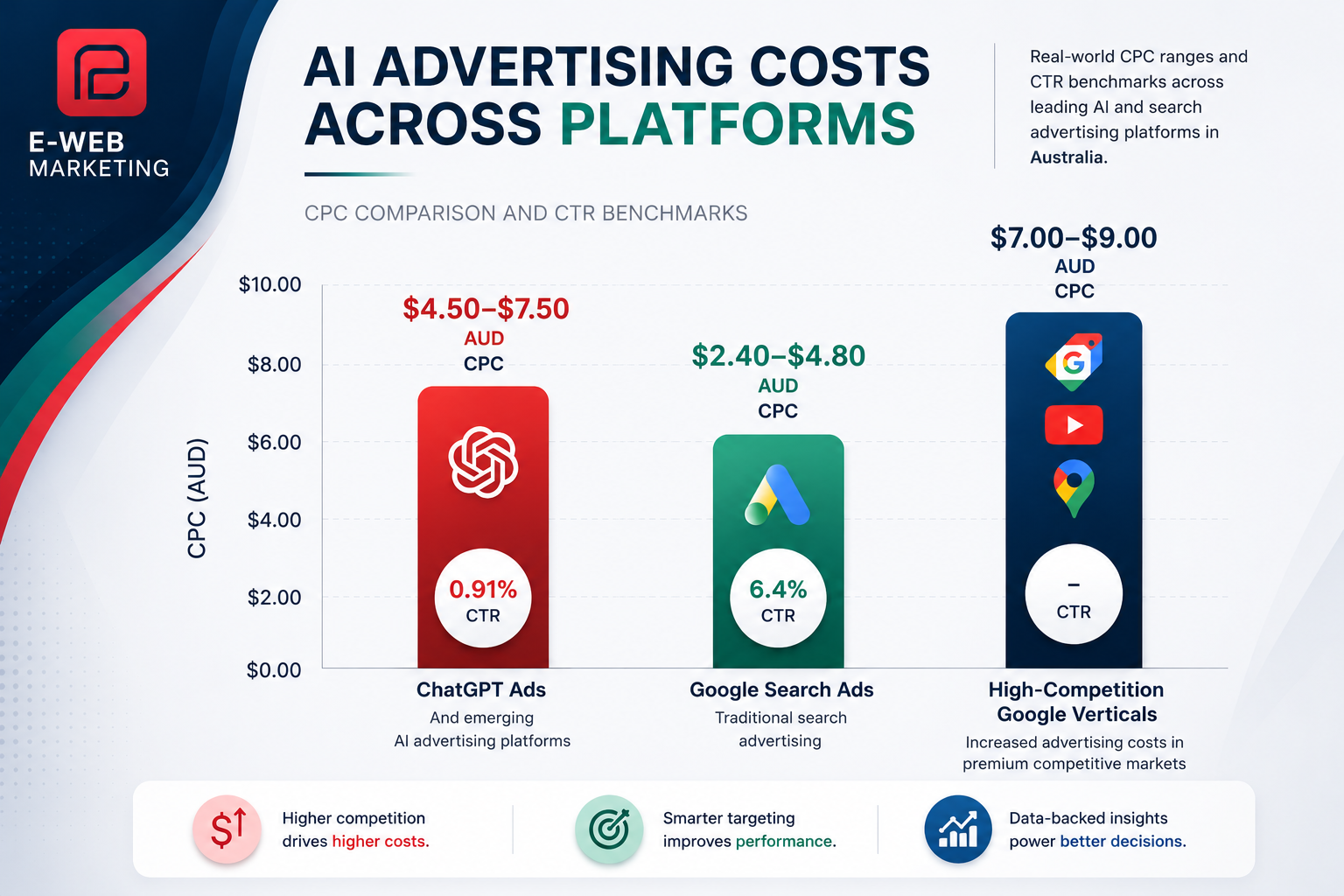
| CTR benchmark | ~0.91% | ~6.4% Search average |
| Attribution maturity | Early stage — limited tooling | Very mature — full conversion suite |
| Audience targeting | Contextual (topic-based) | Keyword + audience + intent signals |
Looking at CPC alone, the two platforms appear comparable. Google Search averages $4.12 AUD per click across all industries, while ChatGPT Ads start at $3–$5. But that surface similarity dissolves when you look at CTR. Google’s 6.4% CTR versus ChatGPT’s 0.91% means your cost-per-thousand-impressions on ChatGPT is far lower, but your cost to generate a click is potentially much higher once you factor in reach. For legal, financial services, and home improvement categories where Google Ads CPCs regularly exceed $7–$9 AUD per click, ChatGPT’s $3–$5 can look very attractive — provided your landing page converts research-phase visitors.
Where Google Ads Wins: What It Still Does Better Than Any Platform
Google Ads has a 20-year head start on every other platform in the paid media space. That matters more than most people realise.
Purchase-intent capture
When someone types a transactional query into Google — ‘buy running shoes Sydney’, ‘best conveyancer Brisbane’, ’emergency electrician 24 hour’ — they have self-qualified as a ready buyer. No other platform offers this signal. The conversion rates that follow reflect it: Google Search averages a 4–8% conversion rate across most categories, compared to the 1–4% being reported early on ChatGPT Ads conversational placements.
Attribution and measurement depth
Google Ads comes with two decades of measurement infrastructure. Conversion tracking, audience insights, attribution models (last-click, data-driven, time-decay), cross-device matching, and SA360 integration are all mature and reliable. You can close the loop from ad impression to phone call to signed contract with precision. ChatGPT’s measurement tooling is still being built.
Reach and inventory scale
Google processes 13.7 billion searches per day globally. The addressable inventory in Australia is enormous, and every ad format — Search, Display, YouTube, Shopping, Performance Max — plugs into the same ecosystem. ChatGPT Ads currently reach only Free and Go tier users in Australia, New Zealand, Canada, and the US, which represents a far smaller addressable audience.
Proven ROI model
For most Australian businesses, Google Ads remains the more predictable and measurable investment. If you are not yet getting strong returns from your current setup, the issue is almost never the platform — it is campaign structure, Quality Score, and bid strategy. Our Google Ads management service is built around fixing exactly those levers.
Where ChatGPT Ads Win: What the New Platform Does Differently
For all of Google’s strengths, there are things ChatGPT Ads do that Google cannot replicate — and those differences are genuinely valuable in the right context.
Reaching buyers before they reach Google
The average B2B buying decision now involves between 6 and 10 research touchpoints before a purchase query is typed into Google. ChatGPT is increasingly where several of those early touchpoints happen — people asking broad questions, comparing options, and building their understanding of a problem. Being present in those conversations, as a sponsored recommendation, puts your brand into consideration before the search intent crystallises. By the time the buyer gets to Google, they may already know your name.
Cookieless by design
ChatGPT Ads are a cookieless advertising environment from day one. There is no third-party cookie dependency, no reliance on browser-level tracking that Apple and Google are systematically removing, and no audience targeting that requires personal data. As third-party cookies continue their slow exit from the open web, this architecture becomes a structural advantage rather than a limitation.
Lower competition — for now
The majority of Australian businesses are not yet running ChatGPT Ads. That is the early mover window. Cost-per-click at $3–$5 will not stay there as more advertisers enter the auction. The businesses running test campaigns now are building optimisation data, learning which creative formats convert, and establishing category presence before the market gets crowded. That playbook is familiar — it is exactly what early Google Ads advertisers experienced in 2003.
High-attention ad environment
When a user is inside a ChatGPT conversation, they are reading carefully. They are not passively scrolling a feed or glancing at a sidebar. A relevant sponsored recommendation appearing after a thoughtful AI response sits in a genuinely high-attention context — more like a recommendation from a trusted source than a display banner competing for peripheral vision.
The Measurement Gap: Why Tracking ChatGPT Ads Is Not Like Tracking Google
This is the section most ChatGPT Ads guides skip over, and it is the one that will burn budgets most reliably in 2026.
Google Ads attribution is mature. Click fires, session is recorded, conversion tracks, campaign gets credit. The loop is closed. ChatGPT attribution breaks this model in three specific ways.
The delayed conversion problem
A user sees your sponsored recommendation inside a ChatGPT conversation on a Tuesday. They do not convert. Three days later, they type your brand name into Google, click your organic result, and become a customer. In standard last-click attribution, Google Organic gets the credit. ChatGPT Ads get nothing — despite being the touchpoint that put your brand in front of them. Industry data from early US campaigns shows this pattern repeatedly: ChatGPT Ads influence decisions that convert through other channels days later.
The UTM parameter problem
ChatGPT Ads are served inside a conversational AI interface that does not always pass URL parameters cleanly. UTM tags should work in principle, but ad environments inside AI-generated responses do not handle this as reliably as a standard search result. Traffic from ChatGPT Ads may appear in GA4 as direct, as referral from chatgpt.com, or as openai.com depending on how the link was surfaced. If you are not tracking this specifically, you are measuring the channel wrong.
What to track instead
The most reliable framework for ChatGPT Ads measurement right now is a multi-signal approach: track UTM-tagged traffic in GA4, watch for branded search lift in Google Search Console in the two to four weeks following a campaign (a measurable increase in people searching your name directly indicates ChatGPT attribution), and treat last-click ROAS as a floor estimate rather than the true return. The channel is working harder than the numbers first suggest.
Industry-by-Industry Fit Guide for Australian Businesses
The right answer to ‘ChatGPT Ads vs Google Ads?’ depends heavily on your industry. Here is how to think about fit across the most common Australian business categories.
| Industry | Google Ads Fit | ChatGPT Ads Fit | Recommended Strategy |
| Professional services (legal, accounting, consulting) | Very strong — high intent, high CPC justifiable | Strong — buyers research extensively before deciding | Run both. Google captures ready buyers. ChatGPT builds early-stage consideration. |
| Home services (trades, renovation, cleaning) | Very strong — emergency and local searches dominate | Moderate — good for research-phase but less for urgent jobs | Prioritise Google. Add ChatGPT test for renovation/design categories. |
| Financial planning & mortgage broking | Strong — high CPC but high LTV | Strong — significant research phase before commitment | Run both. ChatGPT excellent for education-stage positioning. |
| Health & wellness (physio, dental, allied health) | Strong — local searches, clear intent | Moderate — condition research is a fit; booking intent is not | Google first. ChatGPT test for condition/symptom education content. |
| SaaS & digital products | Strong for demo/trial intent | Very strong — technical research phase, high AI user overlap | Ideal for both. Strongest ChatGPT ROI case of any category. |
| eCommerce (product retail) | Very strong — Shopping Ads, branded search | Weak — product discovery needs visual formats; ChatGPT is text | Focus budget on Google Shopping and Search. ChatGPT not a priority. |
| Real estate | Strong — suburb and property type searches | Moderate — suburb-level decision research could work | Google first. ChatGPT worth testing for suburb guides and market research queries. |
| Education & training | Strong — course and qualification searches | Strong — career research and course comparison queries are common | Both. Strong mutual reinforcement here. |
How to Run Both Platforms Together as One Connected Strategy
The question is not ChatGPT Ads vs Google Ads. For businesses where both platforms fit, the question is how to structure them so they reinforce each other rather than cannibalise the same budget.
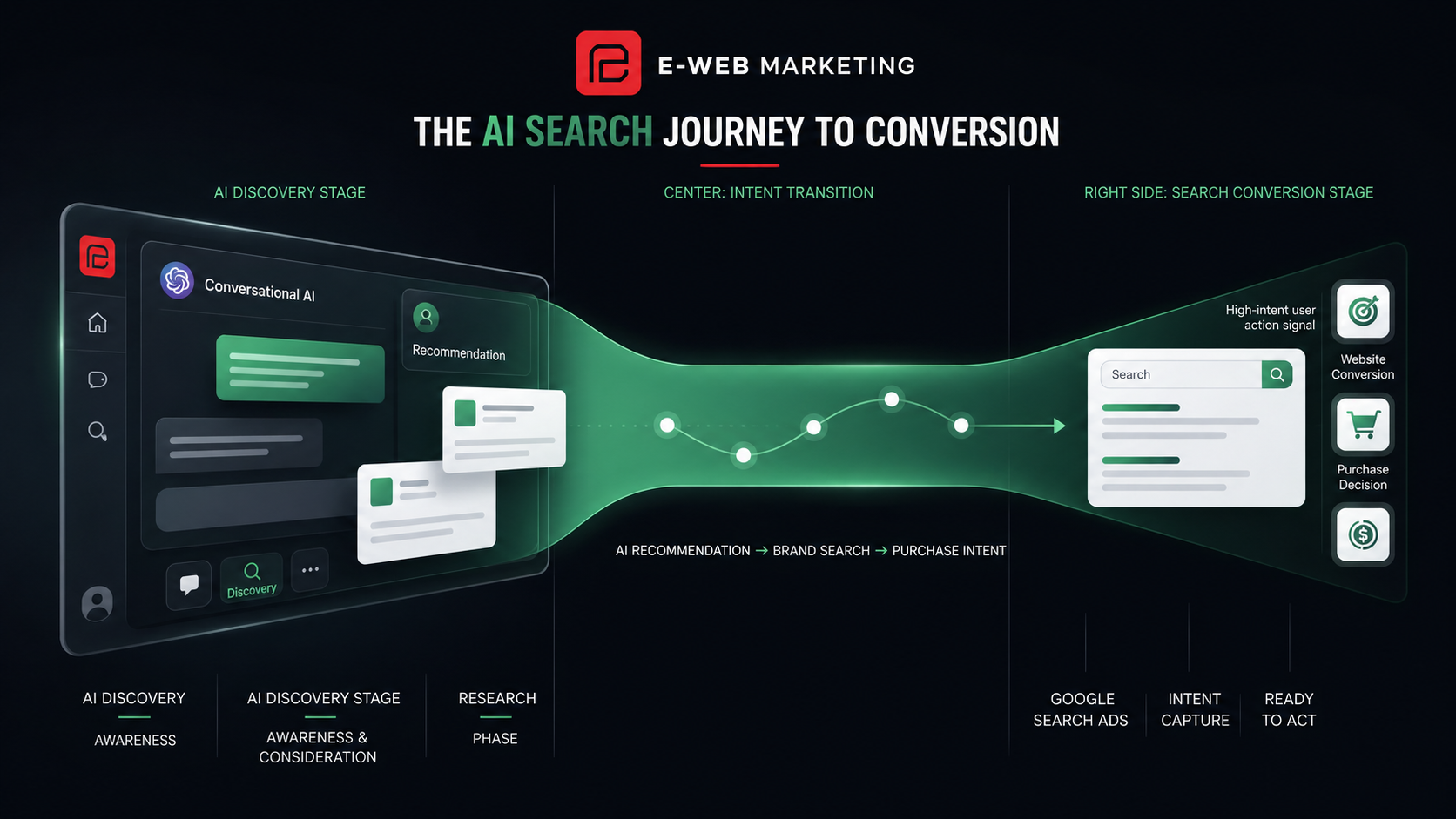
Top of funnel — ChatGPT Ads
Use ChatGPT Ads to reach buyers during the research phase — before they know who they want to hire or which product they want. Your goal at this stage is not immediate conversion. It is brand introduction, problem framing, and positioning. Write ad copy that leads with a helpful statement rather than a sales pitch. ‘Comparing accountants? Here’s what actually matters for small business tax.’ outperforms ‘Award-winning accounting firm — book now.’ in this environment.
Bottom of funnel — Google Search Ads
Google captures the demand that ChatGPT helped create. Once a buyer has done their research — some of which happened in ChatGPT — they move to Google to find the specific business they want. This is where your search campaigns, branded keywords, and conversion-optimised landing pages close the deal. Watch for branded search volume lift in Google Search Console after ChatGPT campaigns run — this is one of the cleanest signals that your upper-funnel investment is paying off.
The organic AI layer underneath both
Sitting underneath both paid channels is the organic AI visibility layer — the work that gets your business recommended in AI responses without paying for the placement. Paid ads stop the moment your budget does. Organic AI recommendations built through generative engine optimisation (GEO) compound over time, work 24/7, and are weighted by AI systems as more trustworthy than paid placements. For most Australian businesses, this organic foundation should be built before or in parallel with any paid AI advertising investment.
To understand the full shift happening in search and why paid and organic AI strategies are converging, our breakdown of AI search trends in 2026 covers the bigger picture that makes these decisions make sense.