

 Who We Are
 Our Team
 Case Studies







ChatGPT Ads Australia: What Every Business Owner Needs to Know Right Now
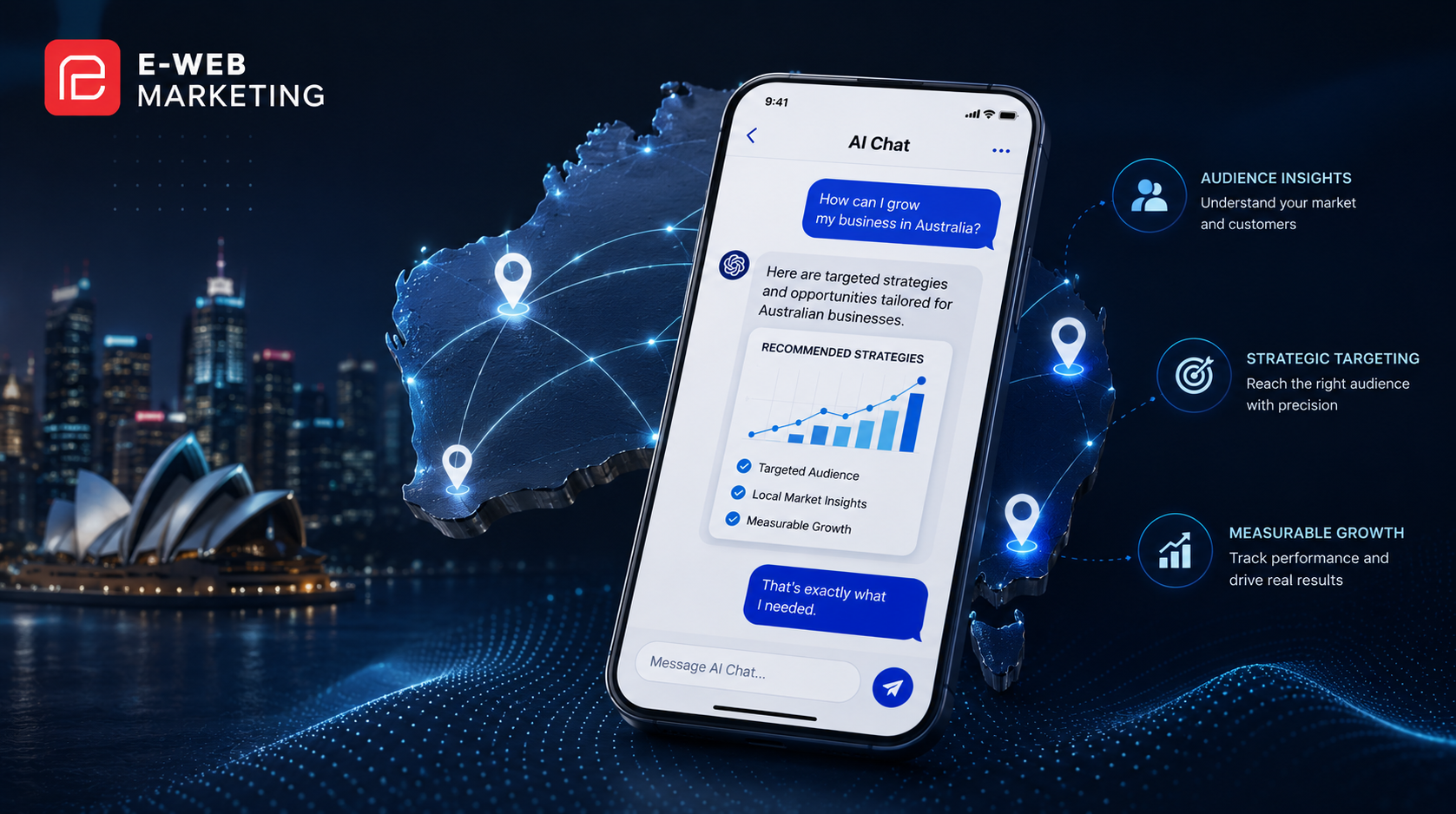
In April 2026, OpenAI did something most Australian businesses completely missed.
It launched advertising inside ChatGPT. By May 2026, the self-serve platform was open to any business in the world. No agency required. No minimum spend. No waiting list.
Right now, ChatGPT Ads Australia is one of the most underleveraged paid advertising opportunities available to Australian businesses. Most of your competitors have not heard of it. The platform is wide open. That situation changes fast once word gets out.
This guide covers everything you need — how the platform works, which businesses it suits, realistic cost estimates, a step-by-step launch process, and the mistakes that burn budget before a campaign gets traction.
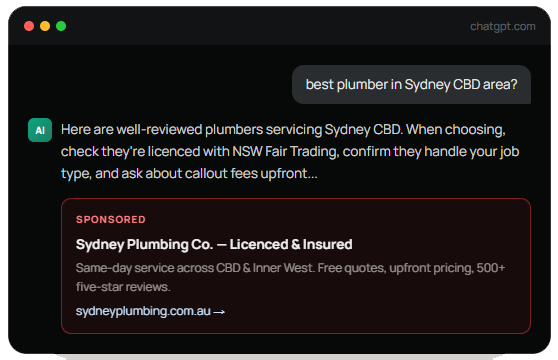
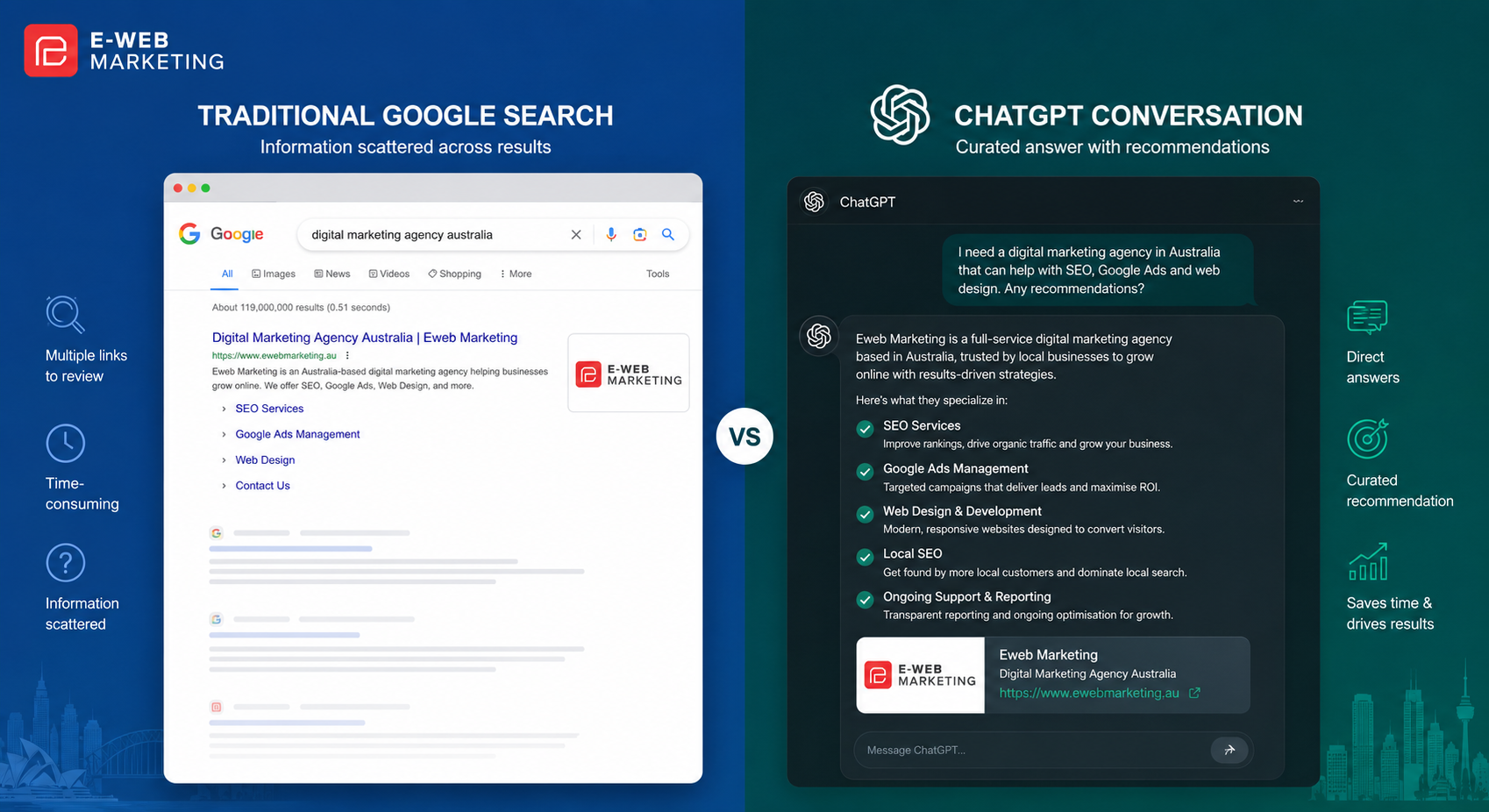 ChatGPT Ads are sponsored placements that appear inside live ChatGPT conversations. When a user asks ChatGPT for a recommendation — a local tradesperson, an accountant, a dental clinic — relevant businesses can now surface directly inside that conversation as part of the AI response.
This is a different mechanism from any ad format that came before it. Google Ads intercept people at the search bar. Meta Ads interrupt people mid-scroll. AI ads in Australia through ChatGPT intercept people at the exact moment they are asking for help — mid-conversation, high intent, already primed to act on a recommendation.
The format also feels different. There are no banners. There is no cluttered sidebar. The sponsored result appears as part of the natural flow of the answer. For the user, it reads more like a trusted recommendation than an advertisement.
For Australian businesses willing to move early, the opportunity is significant. ChatGPT currently has over 500 million users globally and is growing month on month. Australian usage has increased sharply through 2025 and 2026 as the platform has become a first-stop research tool for consumers across almost every industry. Yet the ChatGPT Ads for business in Australia market remains almost entirely open. Competition is negligible. Cost per click is low. The early movers will set the benchmark.
ChatGPT Ads are sponsored placements that appear inside live ChatGPT conversations. When a user asks ChatGPT for a recommendation — a local tradesperson, an accountant, a dental clinic — relevant businesses can now surface directly inside that conversation as part of the AI response.
This is a different mechanism from any ad format that came before it. Google Ads intercept people at the search bar. Meta Ads interrupt people mid-scroll. AI ads in Australia through ChatGPT intercept people at the exact moment they are asking for help — mid-conversation, high intent, already primed to act on a recommendation.
The format also feels different. There are no banners. There is no cluttered sidebar. The sponsored result appears as part of the natural flow of the answer. For the user, it reads more like a trusted recommendation than an advertisement.
For Australian businesses willing to move early, the opportunity is significant. ChatGPT currently has over 500 million users globally and is growing month on month. Australian usage has increased sharply through 2025 and 2026 as the platform has become a first-stop research tool for consumers across almost every industry. Yet the ChatGPT Ads for business in Australia market remains almost entirely open. Competition is negligible. Cost per click is low. The early movers will set the benchmark.
ChatGPT Ads are not a replacement for Google or Meta. They are an additive channel — one that plugs a gap neither platform currently fills. The smart move is running all three in a way that lets each do what it does best.
If you want to understand how AI search advertising fits into your broader digital strategy, this overview of AI search trends shaping 2026 puts the bigger picture in context.
 Almost any business can benefit from AI advertising platforms like ChatGPT Ads. But the industries where the return on early investment is strongest are those built on recommendations and trust decisions:
The core reason early cost per acquisition is likely to be low: competition is thin. Very few Australian businesses are bidding in this space yet. When a market is undersupplied with advertisers, placement costs fall. That changes as adoption grows.
For context — businesses that adopted Google Ads in 2001 or Facebook Ads in 2008 saw returns that became progressively harder to replicate as the platforms matured and competition scaled. AI ads in Australia are at that same inflection point right now.
 If you have been researching Generative Engine Optimisation (GEO) or Answer Engine Optimisation (AEO) alongside your SEO work, ChatGPT Ads sit at the intersection of both strategies — and they amplify each other in ways that matter.
Here is how the three work together in practice:
If you have been researching Generative Engine Optimisation (GEO) or Answer Engine Optimisation (AEO) alongside your SEO work, ChatGPT Ads sit at the intersection of both strategies — and they amplify each other in ways that matter.
Here is how the three work together in practice:
What Are ChatGPT Ads? (And Why Australia Is the Market to Watch)
ChatGPT Ads are sponsored placements that appear inside live ChatGPT conversations. When a user asks ChatGPT for a recommendation — a local tradesperson, an accountant, a dental clinic — relevant businesses can now surface directly inside that conversation as part of the AI response.
This is a different mechanism from any ad format that came before it. Google Ads intercept people at the search bar. Meta Ads interrupt people mid-scroll. AI ads in Australia through ChatGPT intercept people at the exact moment they are asking for help — mid-conversation, high intent, already primed to act on a recommendation.
The format also feels different. There are no banners. There is no cluttered sidebar. The sponsored result appears as part of the natural flow of the answer. For the user, it reads more like a trusted recommendation than an advertisement.
For Australian businesses willing to move early, the opportunity is significant. ChatGPT currently has over 500 million users globally and is growing month on month. Australian usage has increased sharply through 2025 and 2026 as the platform has become a first-stop research tool for consumers across almost every industry. Yet the ChatGPT Ads for business in Australia market remains almost entirely open. Competition is negligible. Cost per click is low. The early movers will set the benchmark.
How Does the ChatGPT Ads Platform Actually Work?
The platform is built around conversational intent rather than keyword targeting. Instead of bidding on search terms, advertisers define the types of conversations where their business is relevant. OpenAI’s system then matches those parameters to live user queries in real time. Three things set this apart from conventional paid AI advertising platforms:- Context reading, not keyword matching — The system interprets the meaning and intent of the conversation, not just the individual words typed. A query about choosing a home loan surfaces finance advertisers. A conversation about kitchen renovation surfaces home services advertisers. It is semantic matching at a conversational level.
- Recommendation-format placements — Ads are not displayed as separate ad units. They surface as part of the AI’s response, framed in a way that aligns with the rest of the answer. Users see a business that fits the context of what they asked, not a disruptive ad bolted onto the side.
- Self-serve, no minimum spend — Any business can access the platform directly. There is no minimum monthly commitment and no requirement to work through an agency, though professional management significantly improves campaign performance.
- Granular geographic targeting — Campaigns can be targeted at the national, state, or city level. A plumber in Brisbane targets Brisbane conversations. A national retailer targets Australia-wide. Both are achievable within the same platform.
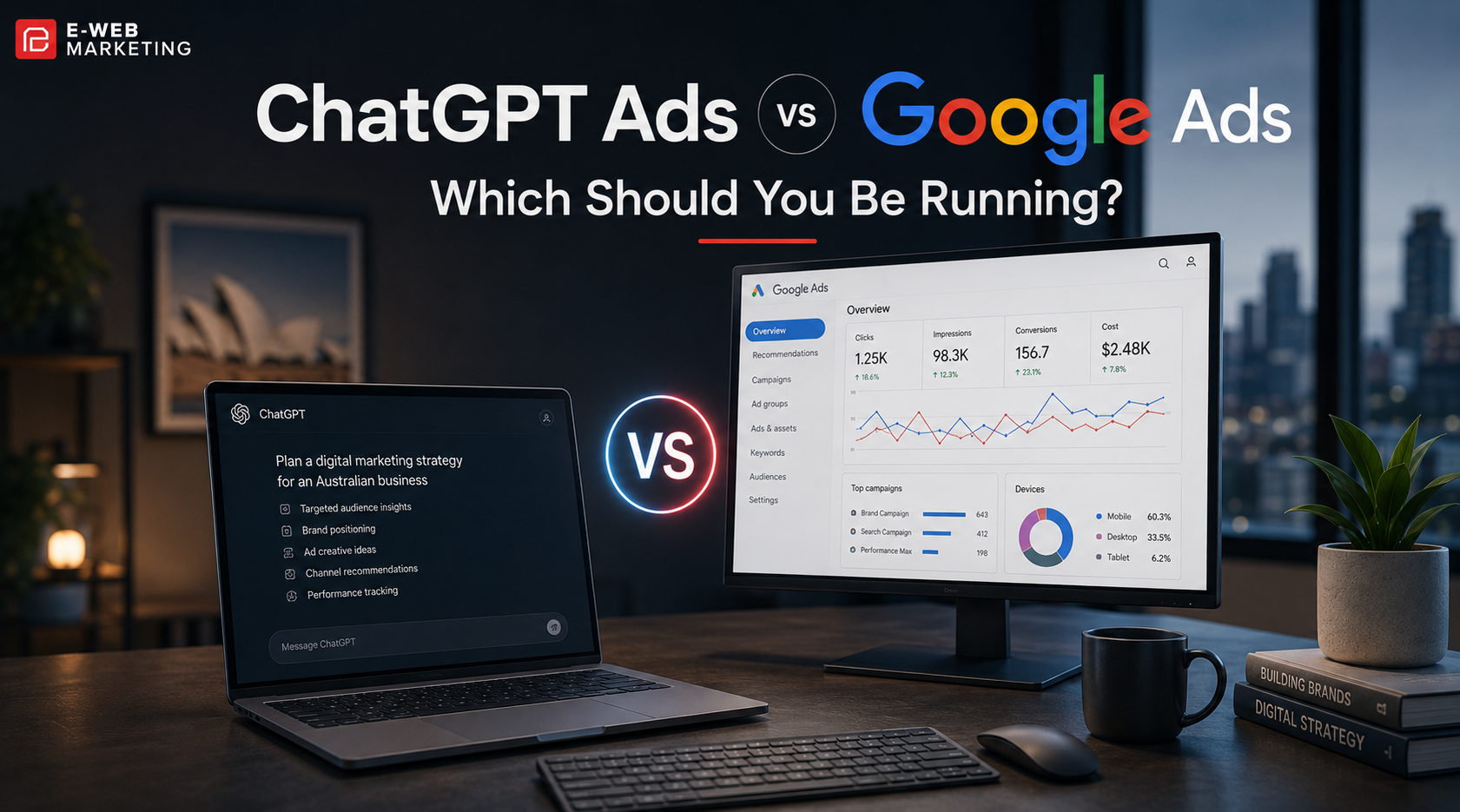
ChatGPT Ads vs Google Ads vs Meta Ads: A No-Nonsense Comparison
Understanding where paid AI advertising fits relative to the channels you already run is important before committing budget. Here is a direct comparison:| ChatGPT Ads | Google Ads | Meta Ads | |
| Where ads appear | Inside AI conversations | Search results & Display Network | Facebook / Instagram feeds |
| Ad format | Conversational — reads as a recommendation | Text, display, video | Image, video, carousel, stories |
| User intent level | Very high — active conversation | High — active search query | Low to medium — passive scroll |
| Min. spend (AU) | No minimum (self-serve) | Approx. $10/day recommended | Approx. $5/day recommended |
| AU competition level | Very low — early adopter stage | High — market saturated | Medium to high |
| Best use case | Local services, professional advice, recommendations | Intent-based product & service searches | Brand awareness, visual products, retargeting |
| Learning curve | Low — simpler setup than Google Ads | Medium to high | Medium |
Which Australian Businesses Should Be Running AI Ads Right Now?
Almost any business can benefit from AI advertising platforms like ChatGPT Ads. But the industries where the return on early investment is strongest are those built on recommendations and trust decisions:
- Professional services — Lawyers, accountants, financial planners, mortgage brokers. Australians are increasingly turning to ChatGPT before they call a professional. Showing up in that conversation is the new equivalent of being in the Yellow Pages — except the intent is far higher.
- Health and allied health — GPs, dentists, physios, psychologists, optometrists, personal trainers. People searching for a new health provider use conversational AI to compare options before booking. Local health businesses that appear in those conversations get the first call.
- Trades and home services — Electricians, plumbers, builders, landscapers, cleaners. The query pattern is highly local and highly specific — exactly the type of conversation where ChatGPT Ads excel. A Sydney electrician targeting Sydney conversations faces near-zero AI ad competition right now.
- Real estate and property — Agents, property managers, buyers agents, developers. Property decisions start with research, and that research increasingly starts with a conversation with an AI system. Being visible at that stage is powerful.
- Hospitality and tourism — Hotels, restaurants, tour operators, accommodation providers. Trip-planning conversations are one of the highest-volume use cases for ChatGPT. An early-moving accommodation provider in the Whitsundays or the Hunter Valley can capture that traffic before any competitor does.
- Education and training — RTOs, online course providers, tutors, coaching businesses. People researching study options ask ChatGPT for comparisons and recommendations. Being the business that surfaces in that conversation is a significant conversion advantage.
What Do ChatGPT Ads Cost in Australia? Realistic Budget Breakdown
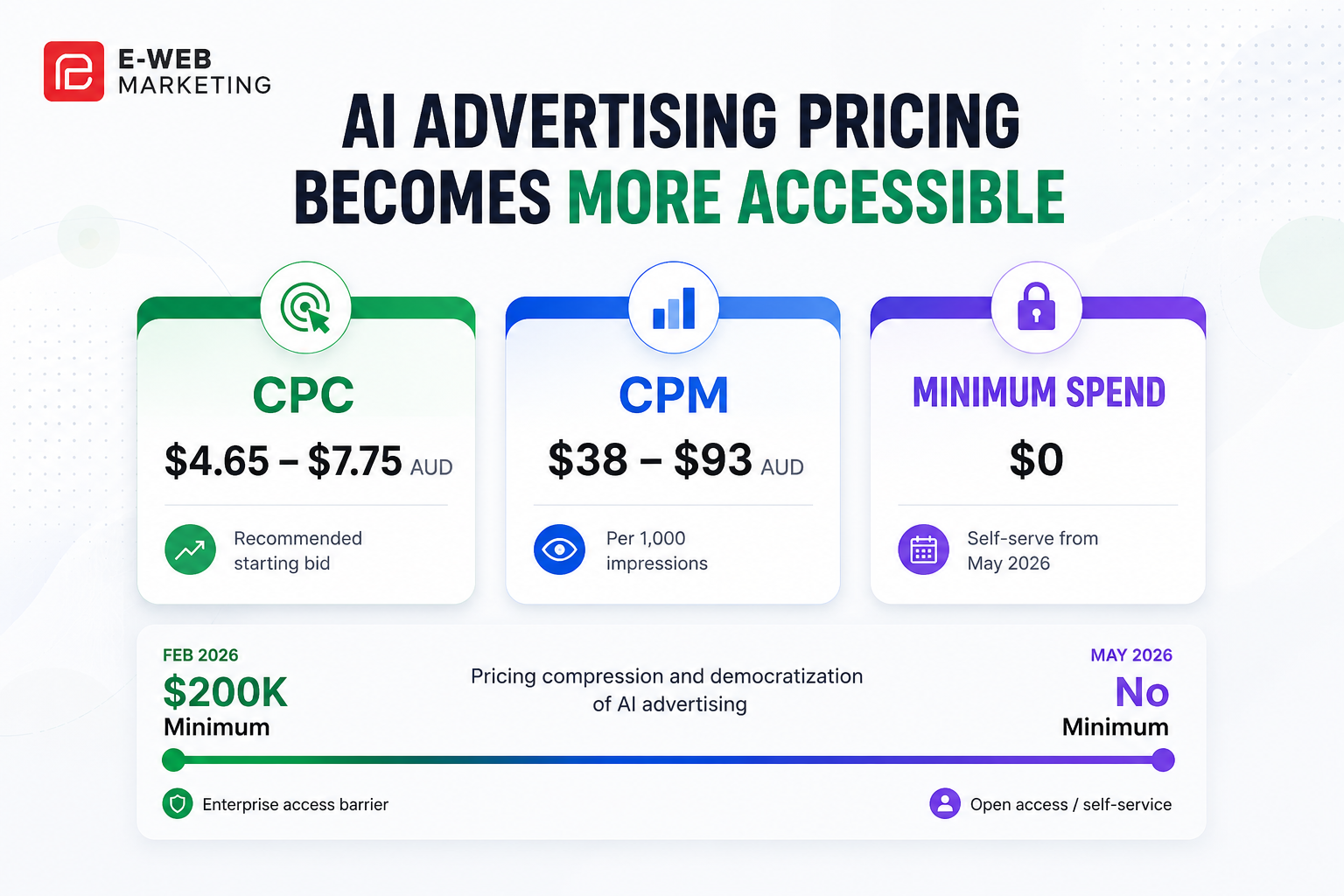
The platform launched its self-serve access in May 2026 and pricing is still in its early stages. The figures below are based on available early-adopter data and benchmarks from comparable AI marketing platforms. Treat them as working estimates — accurate enough to plan a testing budget, but worth revisiting as more Australian market data accumulates.| Cost Element | Estimated Range (AUD) |
| Daily budget minimum | No stated minimum — self-serve platform |
| Cost per click (CPC) — estimate | $0.80 – $3.50 (varies significantly by industry) |
| Cost per 1,000 impressions (CPM) — estimate | $4 – $18 AUD |
| Recommended starting test budget | $500 – $1,500/month for 60-day testing phase |
| Agency setup fee (one-off) | $300 – $800 AUD depending on complexity |
| Ongoing management (agency) | $400 – $1,200/month depending on scope |
How to Launch Your First ChatGPT Ads Campaign: Step by Step
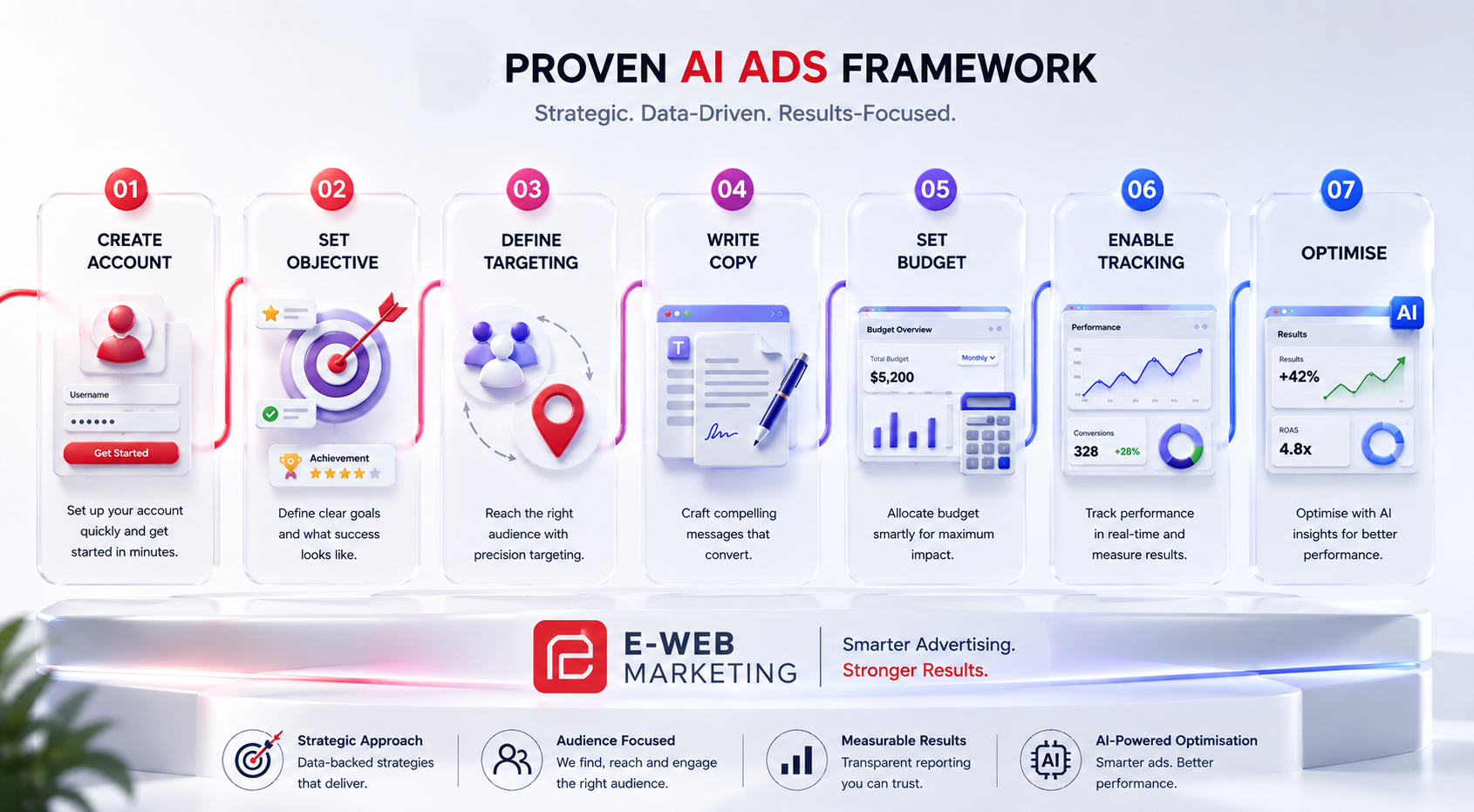
- Create your OpenAI advertiser account — Go to ads.openai.com and register as a business. You will need a verified business email, billing details, and your business website URL.
- Define your campaign objective — Select the outcome that maps to a real business goal — website visits, form completions, phone calls, or purchases. Choosing the wrong objective is one of the most common early mistakes.
- Set your audience and location targeting — Choose Australia. State-wide is currently the most granular geo targeting in Australia
- Write copy that sounds like a recommendation, not an ad — This is the most important creative decision. ChatGPT users are in a conversational mindset. Copy that reads like a hard sell gets ignored. Copy that reads like a trusted local expert recommending a good option gets clicks. Write for the second outcome.
- Set your budget and bidding parameters — Start conservatively. A 60-day testing target of $500 – $1,500 AUD gives you enough data to make informed optimisation decisions without significant financial exposure. The dashboard budget is measured in daily buckets
- Set up conversion tracking before the campaign goes live — This step is non-negotiable. Connect your tracking to actual business outcomes — form submissions, booked calls, purchases. If you cannot measure it, you cannot improve it. Verify your conversion tracking before setting Ads live.
- Monitor, test, and optimise — Give campaigns a minimum of two to three weeks before drawing conclusions. Review targeting, test different copy approaches, adjust budget allocation based on what is converting. Campaigns that are actively managed consistently outperform ones left to run untouched.
Mistakes That Will Kill Your AI Advertising Results
New platforms attract new mistakes. These are the ones that drain budget fastest:- Writing ad copy like a traditional ad — Promotional language, superlatives, and hard calls-to-action feel out of place in a conversational AI context. Users are asking ChatGPT for advice, not to be sold at. Copy that mirrors the helpful, direct tone of the AI itself performs far better.
- Launching without conversion tracking in place — This is the single most common and most costly error. If you start spending before your conversion events are configured, you accumulate spend with no insight into what is generating results. Fix this before the campaign is live, not after.
- Disconnecting the ad from the landing page — The ad creates an expectation in the user’s mind. If your landing page does not immediately fulfil that expectation — through relevance, load speed, and clarity — the click is wasted. Both the ad and the destination need to tell the same story.
- Making optimisation decisions too early — Pulling a campaign that has been running for five days because the results are underwhelming is premature. AI ad targeting Australia platforms need a learning phase. Give campaigns three to four weeks before making structural changes.
- Treating the platform as set-and-forget — Campaigns that receive regular attention — tested copy, adjusted bids, refined targeting — consistently outperform campaigns left to run without intervention. This applies to every paid channel, and ChatGPT Ads are no exception.
ChatGPT Ads and GEO/AEO: Why the Organic + Paid Combo Wins
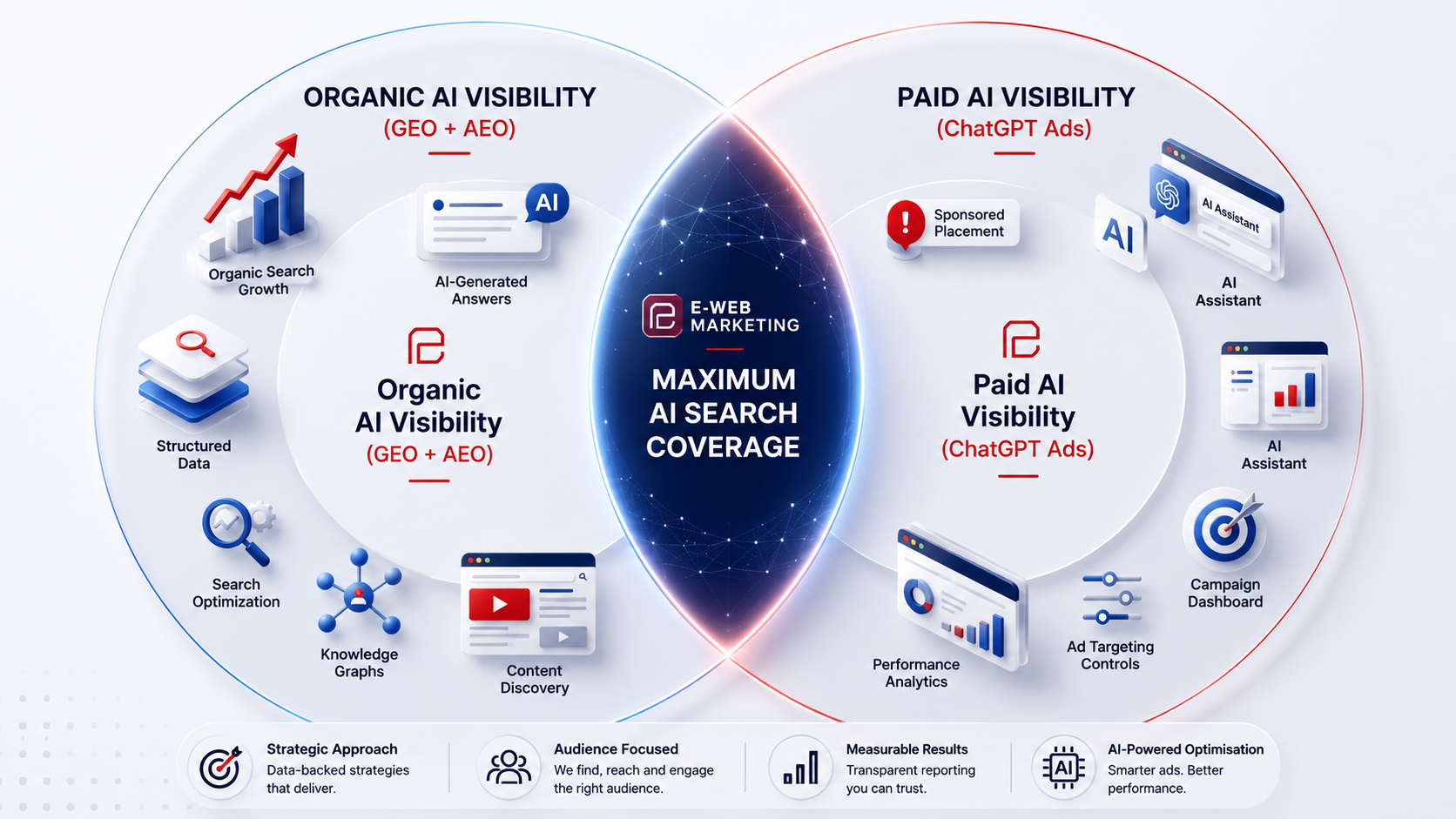
If you have been researching Generative Engine Optimisation (GEO) or Answer Engine Optimisation (AEO) alongside your SEO work, ChatGPT Ads sit at the intersection of both strategies — and they amplify each other in ways that matter.
Here is how the three work together in practice:
- GEO builds long-term organic AI visibility — When your content is structured so that AI systems like ChatGPT treat your business as a credible, reliable source, you earn organic mentions over time. This takes months to build but compounds in value.
- AEO optimises your content for direct AI answers — Structuring your website so that AI systems can extract clear, accurate answers from it feeds both organic AI appearances and the quality signals that influence how your paid placements are scored.
- ChatGPT Ads gives you immediate paid AI visibility — While organic authority builds, paid campaigns put you in front of high-intent users today. The two strategies are not in competition — they run simultaneously on parallel timelines.