

 Who We Are
 Our Team
 Case Studies



AI Search trends in 2026: what every business needs to know
People find information differently now.
If you noticed a dip in website traffic over the past 12 months, you’re in good company.
Organic search traffic that once flowed reliably to well-ranked pages isn’t arriving the way it used to.
But here’s the other side of that story: businesses that adapted early are seeing AI-referred visitors convert at rates that dwarf traditional search traffic. The opportunity is real. It just requires a different approach.
This article breaks down the most important AI search trends shaping 2026, so you know where to focus your marketing energy.
Trend 1: Zero-click search has become the norm
This is the big one.
Across all Google searches, roughly 60% now end without anyone clicking through to a website. When Google’s AI Mode is active, that figure climbs to 93%.
What’s happening? AI Overviews appear at the top of the results page and answer the query so completely that users simply don’t need to go further. The search engine itself has become the destination, not a signpost pointing elsewhere.
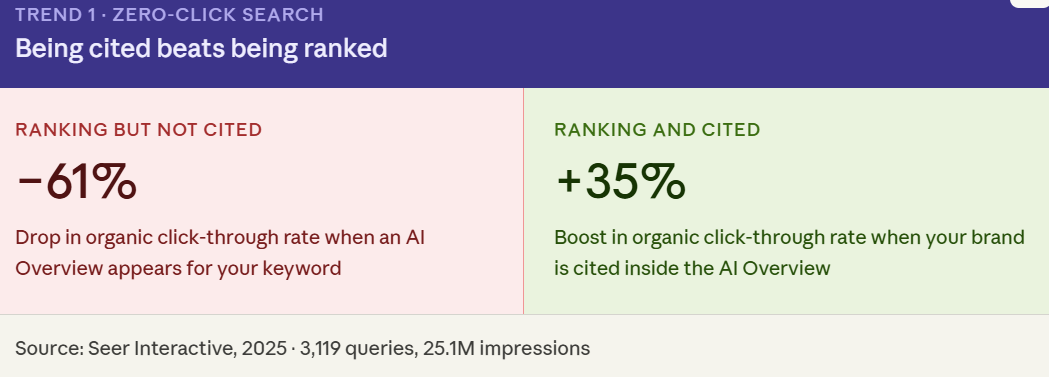
The impact on click-through rates has been sharp. When an AI Overview appears, organic CTR drops from around 1.76% to 0.61%.
That’s right: a steep 61% fall.
For businesses that built their traffic strategy around organic rankings alone, this is a genuine disruption.
But there’s a nuance worth understanding: when your brand is cited in an AI Overview, organic CTR is actually 35% higher than average.
Zero-click search isn’t the end of digital visibility. It’s a redefinition of what visibility means. Being named in the answer is now more valuable than sitting at the top of a list of links.
Trend 2: AI referral traffic converts exceptionally well
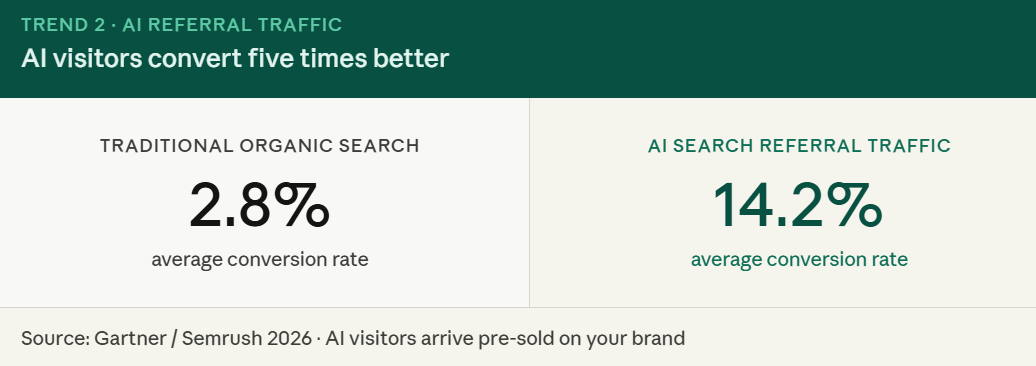
The volume of traffic arriving from AI platforms is still modest compared to Google – but its quality is exceptional.
AI search visitors convert at around 14.2%, compared to just 2.8% for traditional organic search. That’s a five-fold difference. When someone visits your site from a ChatGPT or Perplexity response, they arrive after seeing your brand is a recommended solution. This builds trust before they reach your website.
The overall volume of AI referral traffic is also growing rapidly. AI platforms generated over 1.1 billion referral visits in June 2025. That’s a 357% increase year-on-year.
It’s still early enough for small and medium businesses to enter this channel without fighting big competitors for position. But take note: that window will not stay open.
Trend 3: The AI search market is maturing
When ChatGPT launched, it dominated AI search almost entirely. That’s no longer the case.
ChatGPT remains the largest platform by market share and referral traffic, processing over 1 billion queries a day and reaching 800 million weekly active users as of late 2025.
But Google Gemini has grown aggressively, integrating directly into Google Search, Android and Google Workspace – giving it a distribution advantage that standalone AI products simply cannot match.
Perplexity has carved out a distinct position as a citation-first platform, favouring fresh, expertly sourced content and providing direct clickable links to sources. It remains a meaningful driver of referral traffic, especially for research-oriented queries.
What does this mean practically?
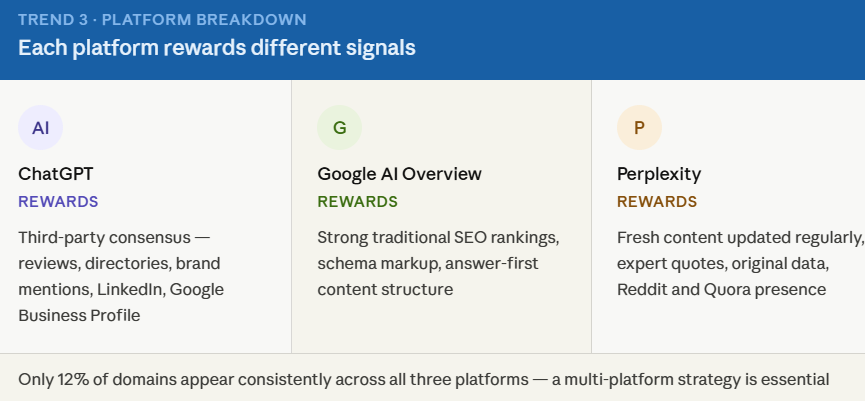
Each platform rewards different things.
ChatGPT values third-party consensus: reviews, directories, mentions across the web. Google AI Overviews heavily favour sources that already rank well in traditional search results. Perplexity prioritises recent content and expert depth.
A strategy that targets one platform while neglecting the others limits your brand’s visibility.
Research shows that only 12% of domains appear consistently across all three major AI platforms. This means most businesses are invisible on at least two of the three most important AI search tools their customers use.
Trend 4: Commercial queries are arriving in AI search
There was a long-held assumption that people use AI tools for research and information, then head to Google to make buying decisions. That split is eroding quickly.
Commercial keywords triggering AI Overviews in Google grew from 8% to nearly 19% between October 2024 and October 2025.
Roughly 9.5% of ChatGPT prompts are now commercial in intent. People ask AI tools to recommend service providers, compare products and help them make purchase decisions – not just to explain concepts.
This shift impacts businesses: AI visibility is no longer just a brand awareness strategy.
It’s a conversion channel, too.
Trend 5: AI agents are beginning to act on behalf of buyers
This trend seems furthest away, but it’s already on its way.
ChatGPT’s Agent Mode, launched in mid-2025, allows users to delegate tasks that go beyond answering questions: booking appointments, researching suppliers, and initiating purchases.
Google’s AI Mode rolled out agentic capabilities around the same time, and Google’s Universal Commerce Protocol (UCP) now allows product discovery and checkout to happen directly inside AI Mode without the user visiting an external website.
For businesses, the implication is significant.
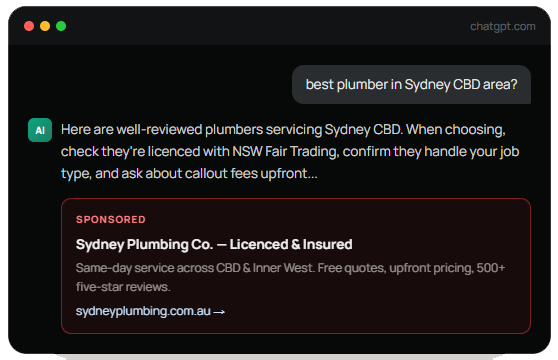
An AI agent researching options on behalf of a buyer needs to be able to find, read and trust your content just as a human would. Technical accessibility, structured data and a clear, consistent brand presence across the web are no longer optional refinements.
They’re the minimum required to participate.
Trend 6: Content authority matters more than ever, but so does freshness
AI citation patterns reveal something surprising: domain authority alone does not guarantee visibility in AI responses.
What matters is the combination of genuine topical expertise on a specific page, clear and structured content, and currency.
Pages updated within 60 days are nearly twice as likely to appear in AI answers.
Content that includes statistics, expert citations and original data earns 30 to 40% higher AI visibility. Sites implementing structured data and FAQ sections have seen AI citation rates increase by 44%.
At the same time, the concentration of citations among a narrow set of authoritative domains is real. Roughly 40-55% of ChatGPT and Perplexity citations flow to fewer than 1,000 domains.
The most-cited sources across AI platforms are Wikipedia, Reddit, LinkedIn and major news publications. They’re consistently trusted by wide audiences over a long period.
For businesses, this means the path to AI visibility runs through the same things that have always built online authority: genuinely useful content, credible third-party mentions and a well-organised, technically sound website.
The difference? These signals now need to be maintained actively, not just established once.
Trend 7: Search is spreading across more platforms
Google processes around 8.3 billion searches a day and holds over 90% of the traditional search engine market.
But search behaviour overall has fractured:
- YouTube is the second-largest search engine on the internet.
- TikTok and Instagram have become genuine product discovery platforms, particularly for younger audiences.
- LinkedIn is the most-cited domain for professional queries across AI Overviews, ChatGPT, Microsoft Copilot and Perplexity.
Reddit threads and Quora answers are among the most frequently sourced content in AI responses.
This is what Search Everywhere Optimisation recognises: the customer’s discovery journey rarely begins and ends in one place. A business that’s visible across multiple platforms benefits from each touchpoint reinforcing the others.
Consistent brand presence across platforms is itself a trust signal that AI tools pick up on.
What this means for your business in 2026
Visibility in 2026 is no longer measured primarily by where you rank in a list of ten blue links. It’s measured by how consistently your brand is present, trusted and cited across every platform where your customers go looking.
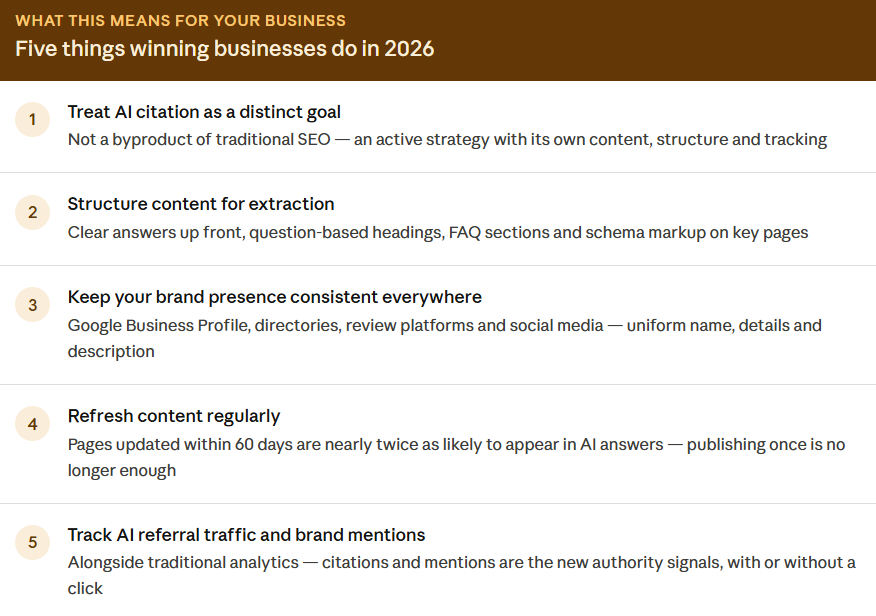
The businesses that are winning are those that:
- Treat AI citation as a distinct goal, not a byproduct of traditional SEO
- Create content structured for extraction: clear answers, question-based headings, FAQ sections, schema markup
- Maintain their presence consistently across Google Business Profile, directories, review platforms and social media
- Refresh content regularly rather than publishing once and moving on
- Track AI referral traffic and brand mentions alongside traditional analytics
Thankfully, you don’t need to rebuild everything.
You’re just expanding what good SEO already does: building genuine trust through useful, well-structured content. But this time, on a wider set of platforms.
Not sure where your business stands right now?
E-WEB Marketing offers a free AI visibility check that shows how your brand currently performs across AI and traditional search, before you spend a cent. Our Sydney-based team has helped over 3,000 businesses grow their online presence through 25 years of industry change, and we’re ready to help you navigate this one.
Book your free AI visibility check or call us on 1300 792 811 to find out more.